| Make
|
Renault |
| Model |
R-Space |
| Concept
year |
2011 |
| Production
year |
- |
| Engine |
Turbocharged
0.9 litre 3-cylinder |
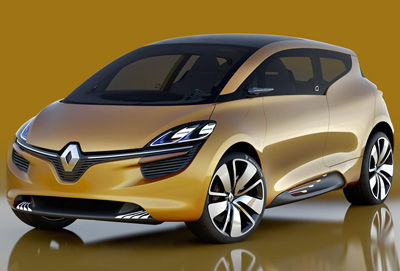
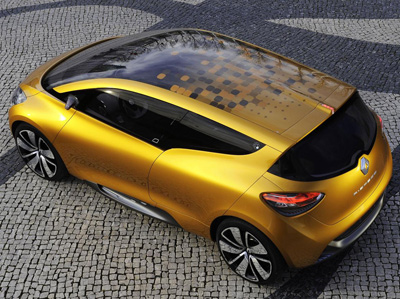
At the 2011 Geneva Motor Show Renault pulled the covers
off the R-Space concept, a family car which displays all
the styling elements of Renault's new look design language.
It's got a family resemblance to Renault's other Geneva
2011 concept, the Renault
Captur, and also the recent Renault
DeZir.
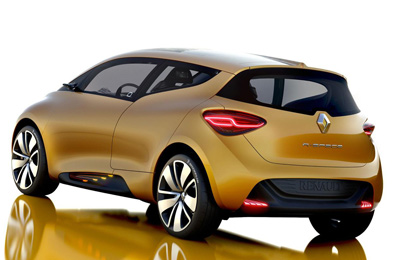
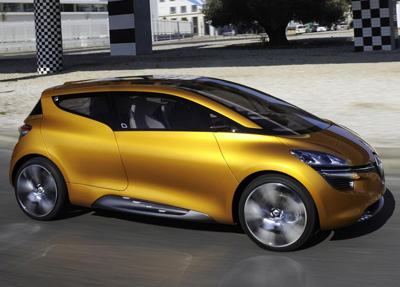
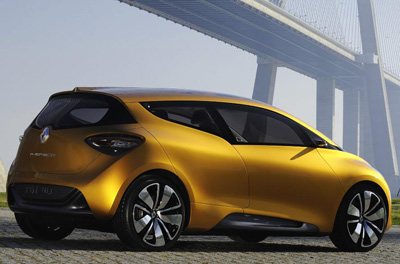
As far as family cars go the R-Space is a good looking
machine, it's still got the efficient one-box layout,
but it's broken up by unusual window shapes and a rakish
windscreen and roofline.
Axel Breun, Director of Design for Concept and Show Cars
at Renault said of the R-Space concept: "R-Space
brings together qualities long considered opposed: family,
functionality, sportiness and sensuality. It answers the
expectations of a large slice of our modern society."
Quite whether the R-Space can cure all of society's dilemmas
through its stylish design remains to be seen. Chances
are it won't. But that doesn't mean it isn't a funky looking
motor which will appeal to a decent slice of those in
the market for a new, practical family vehicle.
Powering the Renault R-Space is a 0.9 litre turbocharged
3-cylinder engine. That's small by anyone's standards,
however its output of 110 hp and 160 Nm of torque means
it will easily keep up with most other standard family
cars, while at the same time using much, much less fuel.
Similar and related vehicles:
Renault Captur
Renault DeZir
Renault R-Space press release:
The brief given to the designers was to come up with a
simple, sensuous and welcoming family vehicle to express
Renault’s new design philosophy in the MPV class. To achieve
this, the designers combined sensuality with a monospace
architecture. The result is a compact people carrier measuring
4.25 metres in length, and with a silhouette that is flowing,
powerful and sporty.
"R-Space brings together qualities long considered opposed:
family, functionality, sportiness and sensuality," explains
Axel Breun, Director of Design for Concept and Show Cars.
"It answers the expectations of a large slice of our modern
society."
The tapered profile of the side windows emphasizes the
dynamic profile, while the large windscreen and panoramic
roof - the thickness of which gradually changes - transform
the passenger compartment into a cozy cocoon of shade.
The nose of R-Space adapts the new visual identity (centred
on the large, vertically-oriented Renault lozenge) to
the proportions of an MPV. The body panels are shaped
as sculptured volumes, meaning that the eye is drawn much
more to reflections and the play of the light than to
the lines themselves.
The body design uses strong forms inspired by the human
body. "With R-Space, it was the pent-up energy in tensed
muscles that inspired me," reveals Fabrice Pouille, exterior
designer. "I wanted to make people feel the urge to caress
the body, to make it sensuous - despite the fact that
this is an MPV aimed at families."
Renault’s strategic sequence of concept car designs brings
with it a parallel progression in their colors: starting
with the passionate red of DeZir, future concept cars
will follow the sequence of the chromatic circle. Coming
after the orange employed for Captur, R- Space is clad
in honey-gold bodywork.
The theme being that of the family, it was the image of
the family Sunday breakfast that provided the inspiration
for R-Space's colors and materials. "The tenderness and
warmth of these shared moments find their expression in
tones that are hot and 'sweet': the white of the milk,
the golden shades of the honey, the brown of the chocolate,"
explains Laurence Widmer, Head of Colors and Materials
on the R- Space concept car. The theme of softness and
sweetness is also mirrored in the choice of materials
- including suede - which are lush to look at and pleasing
to the touch.
As the pioneer of the MPV, Renault is putting forward
R- Space to take the notion a step further. To achieve
this, the designers took as their starting point the notion
that had made the model such a success in the past: the
intelligence of the concept itself.
Interior designer Alexandre Gommier explains: "To reinterpret
this idea in a modern context, we provided a strong visual
and functional contrast between the driver environment,
where the focus is on driving pleasure, and a surprising
and highly-original rear section conceived as a play space
for children."
The scene comes to view as soon as you open the double
doors which, unobstructed by any central pillar, give
clear access to a spectacular interior designed to trigger
strong emotions from the very first glance.
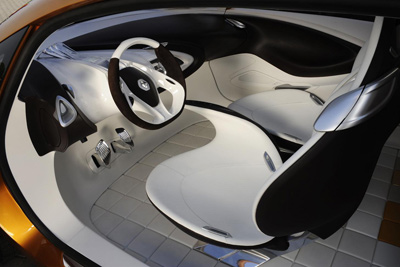
In terms of interior design, the family likeness to the
DeZir concept car is clearly visible at the front in the
forms of the dashboard and seats. The driver enjoys a
cockpit-like environment, with a section of the seemingly
floating dashboard being specifically dedicated to driving
functions. The interlinking movement suggested by the
shaping of the front seat backrests is a return to the
idea of a couple in love.
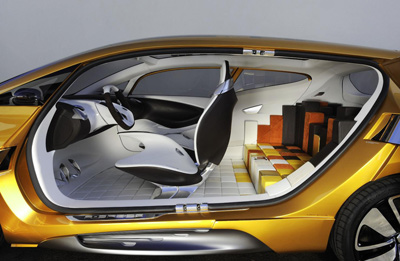
At the rear of the R-Space, the design revolves around
children. This is a play space, flexible and infinitely
versatile, and formed from a simple and universal shape
– the cube. Twenty-seven miniature motors power an array
of height-adjustable hexahedrons, allowing four settings
to be programmed, from an all-flat surface, to a booster
seat, a table or a random configuration (only when the
vehicle is parked) for children's games. The cube is a
consistent theme in furniture design but not something
one expects to come across in the world of cars: in R-Space’s
cabin, however, it is very much in evidence – to the extent
of even forming the covering for the floor and door casings.
The Renault R-Space is powered by the Energy TCe Concept.
Packed with advanced features, this direct-injection petrol
engine previews the new range of modular TCe engines that
Renault will begin launching onto the market next year.
With a capacity of 900cc, this three-cylinder concept-engine
is a product of the Renault-Nissan Alliance. Mated to
an automatic EDC double clutch gearbox, it provides the
performance of a 1.6 litre engine, with peak power of
110hp/80kW and 160Nm of torque. Its CO2 emissions have
been kept to just 95g/km, equivalent to fuel consumption
of just 3.7 litres/100km. |
|