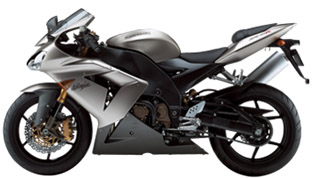
External
review by TulsaT
I have only had my 2005 Kawasaki ZX-10R for a couple of months
now, but I've put over 1200 miles on it. I don't get to ride
every weekend either. So far I love it! I did purchase a steering
damper for it, as it has a tendancy to get a little hairy sometimes
under hard acceleration (when the front-end gets light). It
has plenty of power, I haven't had the opporunity to race anyone,
yet. But I'm sure I'll be pleased when the opportunity arrives.
I remember reading many reviews before I purchased this bike,
saying these bikes have a "musical" engine. If musical means
noisy, then I agree. You can definately hear valve-train action
down there, guess I need to buy a louder pipe so I don\'t have
to listen to it... Overall, I'd say it's a sweet bike, but what
do I know. Winter sucks here!!! I'll spend more time looking
at it than riding for the next 3 months :(
The Kawasaki NINJA ZX-10Rs design, which combines high
technology with the latest innovations, including a high-output
engine, ultra-narrow aluminum frame, ergonomic design and compact
bodywork narrower than most 600cc sportbikes. These attributes
also make the ZX-10R one of the lightest 1000cc bikes on the
market, giving it a superior power-to-weight ratio.
To create this high-performance benchmark, Kawasaki engineers
began by utilizing a stacked shaft design for the extraordinarily
compact, liquid-cooled, 998cc inline four-cylinder engine. The
crank axis, input shaft and output shaft of the NINJA ZX-10R
engine are positioned in a triangular layout to reduce engine
length, while the high-speed generator is placed behind the
cylinder bank to reduce engine width. With a bore and stroke
of 76 x 55mm, the ZX-10R engines one-piece cylinder and
crankcase assembly reduces weight and increases rigidity. The
double overhead cams are machined from chromoly steel billet
for strength, four valves per cylinder improve high-rpm breathing,
and the forged, lightweight pistons offer high heat resistance
to further enhance the bikes power-to-weight ratio.
To obtain maximum benefit from the ZX-10Rs digital fuel
injection, engineers turned to advanced flow analysis to streamline
the engines intake tract. A Ram Air duct located at the
front of the fairing pressurizes the airbox at speed, while
the fuel injection assembly features electronically controlled
sub throttles to smooth power delivery. An ultra-lightweight
titanium four-into-one exhaust system incorporates a butterfly
valve at the collector to improve overall power characteristics.
The titanium oval-shaped muffler is wrapped with a sheet of
ultra-thin walled aluminum and has a non-restrictive honeycomb
catalyzer to reduce exhaust emissions.
In addition to liquid cooling, the ZX-10R engine features a
liquid-cooled oil cooler adjacent to the oil filter to reduce
oil temperatures. Slosh analysis was also used to
design the internal structure of the oil pan, thereby reducing
windage losses and helping to maintain low oil temperatures.
A back-torque
limiting clutch transfers power to a six-speed, close-ratio
transmission idealized for closed-course competition. The back-torque
limiting function automatically disengages the clutch under
hard braking and deceleration to prevent rear wheel hop during
corner entry.
The engine is bolted into an all-aluminum twin-spar frame that
arches over the engine rather than around it, as with conventional
sportbike designs. Constructed of thin-walled castings and pressed
aluminum sheets welded together for optimum lightness, the ZX-10R
frame provides exceptional stability and responsive handling,
yet is no wider than most 600cc sportbikes.
Front suspension duties are handled by fully adjustable 43mm
forks and many of the forks internal parts are crafted
from aluminum to minimize weight. A gull-type aluminum swingarm
connected to Kawasakis UNI-TRAK® linkage and a fully
adjustable shock handles rear suspension duties. The entire
rear suspension system is both lightweight and torsionally rigid,
and also features adjustable ride height.
The ZX-10R features lightweight six-spoke, cast-aluminum wheels.
By utilizing six spokes in place of the traditional three-spoke
design, engineers were able to reduce rim thickness, yet the
wheels are both stronger and lighter. To provide as much traction
as possible, the ZX-10R rides on a 120/70ZR17 front tire and
ultra-wide 190/50ZR17 rear tire.
Stopping power for the ZX-10R is provided by dual 300mm front
disc brakes featuring petal disc design, radially mounted four-piston
calipers, and a single 220mm rear petal disc brake. First introduced
on Kawasakis own NINJA ZX-6R and ZX-6RR sportbikes, the
radial front brake design utilizes mounting points at both the
top and bottom of the caliper, with the mounting bolts inserted
through the rear of the caliper instead of the side or front
as on conventional designs. This racing-inspired setup makes
the caliper more rigid to improve brake feel over a wider range
of operation.
With the help of a front area smaller than most 600cc sportbikes,
the angular body work and racing-style ergonomics of the ZX-10R
minimizes aerodynamic drag on the race track. A central ram
air duct incorporated into the nose of the fairing provides
cool, dense air to the airbox, which is situated between the
frame tubes. The top portion of the fuel tank is also concave,
so the competition rider can tuck in tightly behind the small
windscreen.
Pop nuts are used to fasten the bodywork to the frame, making
disassembly and service easier, and the light, five-piece tail
section opens at the top for easy maintenance.
Other features include multi-reflector headlights, forged aluminum
handlebars that are gun-drilled to reduce weight, LCD display
with radial tachometer and digital speedometer, plus a stop-watch
function and LED tail light.