| Year |
2011 |
| Engine |
4.2
litre V8 twin-turbo |
| Transmission |
6-speed,
paddle shift, RWD |
| Max
speed |
186
+ mph |
| 0-60
mph |
- |
| Horsepower |
700
hp @ 6,500 rpm |
| weight |
approx
1350 kgs / 2976 lbs |
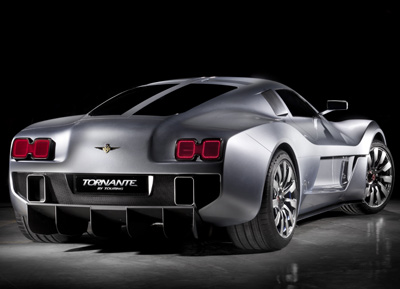
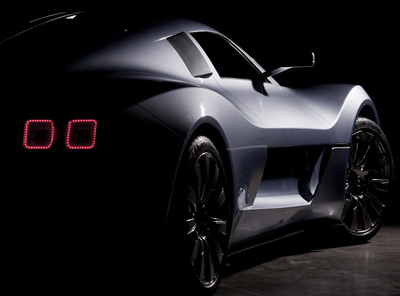
At the 2011 Geneva Motor Show the German supercar company Gumpert
unveiled their second model, a two-seat GT car called the Gumpert
Tornante.
Since 2005 Gumpert have been making the Apollo,
a giant-slaying supercar which eschews glamor and glitz for
breathtaking performance and track success.
One of the biggest 'complaints' concerning the Gumpert Apollo
is the fact it's not the most comfortable or relaxing supercar
to drive. In fact it's a bit of a handful. Therefore for Gumpert's
second model they've decided to do a more luxurious GT car.
The other area in which the Apollo has come in for criticism
is the styling. The euphemism would be to call it 'controversial'.
To prevent the same styling issues from affecting the new car,
it is being designed by the Italians at Carrozzeria Touring
Superleggera in Milan.
Carrozzeria Touring Superleggera's previous works include the
Maserati GranSport Coupe-based A8GCS.
The Gumpert Tornante is powered by a 700 horsepower mid-mounted
4.2 litre twin-turbo V8 engine cradled within a lightweight
spaceframe chassis constructed from chrome-molybdenum steel.
The Tornante features the original Superleggera (superlight)
construction principle and also features a carbon fiber monocoque
and composite body panels.
Similar and related vehicles:
Gumpert Apollo
Touring Superleggera A8GCS
Gumpert Tornante press release:
Fast Tourer
GUMPERT have gained a reputation for their impressive street
legal racing cars. They addressed TOURING SUPERLEGGERA with
a call for elegance, more passengers and luggage space, improved
comfort, access and ventilation, and noise reduction. However,
the fundamentals of performance and dynamic properties had to
be respected without compromise.
At TOURING, designers and body engineers started then a process
of creative elimination to define the true essentials of all
the parameters involved, limiting unnecessary weight and volume.
The result is still a thoroughbred, just a few grades more civilized,
with some extra skills for an enjoyable voyage. It is called
a Fast Tourer. However, let there be no misunderstanding about
its intentions.
Project development
When selecting the partner for the new model's body design,
GUMPERT recognized that elegance is part of the genetic code
of TOURING SUPERLEGGERA's creations. Even more remarkably, the
paradigm of elegance was applied by TOURING to the race cars
too. This distinctive approach was at the basis of many masterpieces,
like the 1940 Mille Miglia winner BMW 328 Berlinetta, the Ferrari
166 and 340 and the inspiring Alfa Romeo 8C2900. They all were
redoubtable race machines with singular grace.
In turn, TOURING was intrigued by the challenge from the young,
vital and ambitious sports car manufacturer, known for uncompromised
orientation to efficiency, high quality engineering and the
constant quest for better performance. In the development work,
the teams from the two companies discovered soon that they share
the same respect for efficiency and essentially. This facilitated
the subsequent stages of engineering and feasibility study,
and the merger of body and chassis required only minor adjustments
from both sides.
Architecture
The space frame chassis is a derivative of the Apollo and features
the same central engine layout. However, the requirements of
accessibility and inner space have dictated a number of important
changes to the rolling chassis:
- the lateral member of the chassis is lowered by 80 mm in the
door area
- the A pillar and the windshield are rotated vertically by
2.5°
- the B pillar is moved backwards with 100 mm allowing for 1120
mm wide gull-wing doors
- the H point is displaced by 210 mm in height and 46 mm in
length
- the overall height is now 1215 mm
Thanks to the thorough frame engineering, the outstanding combination
of lightness and torsional stiffness of the original chassis
is preserved. The engineers target 100 kg and slightly lower
than 40.000 Nm/degree, but the passenger compartment volume
is now increased by 25 percent and the luggage compartment capacity
is brought to 200 litres.
A crash box in the front section, adapted from Formula-1 technology,
absorbs the impact energy in case of a crash, improving the
passive safety. Featuring composite body panels over the light
chrome-molybdenum steel space frame with carbon fibre monocoque,
the construction principle mirrors the original method patented
by TOURING in 1936, and authorizes the symmetrical Superleggera
badges on the hood.
Design
Unlike other TOURING creations, the Gumpert Tornante is not
rooted into a specific model of the Italian designer's heritage.
Aesthetically, the project started from a white sheet of paper,
allowing the designer’s full and free focus on the challenging
package of the rolling chassis and its hard points. The new
model should not only offer ample performance and superb dynamic
properties and aerodynamics, but also adequate levels of comfort,
interior space and ergonomics. The spirit of a true dream car,
but with sufficient practical features to become a safe and
useable sports car in today's traffic.
The TOURING accent of the Gumpert Tornante originates from specific
proportions and the balance of muscular elegance and introvert
power, rather than formal language. The bodywork preserves its
movement even when the car stands still, and when on the move,
it expresses unique, elegant fluidity.
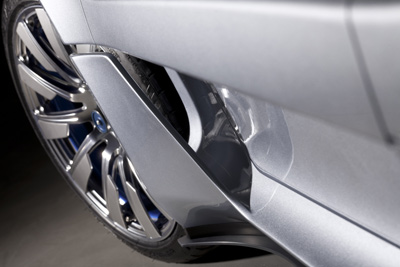
The prominent grille within the balanced front wings characterizes
the Tornante’s front area. The air intakes are pronounced, reflecting
the care given to the air intake surface and the overall airflow.
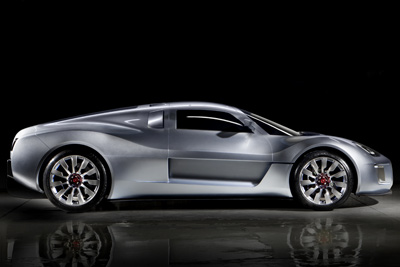
The well-defined waistline reflects the functional separation
between the greenhouse and the lower body. The top is a light
area offering extended space for driver and passenger, overall
visibility and sportive but comfortable ‘life on board’. The
muscular, though elegant shoulders announce the stunning performance
of the power unit. Both the Tornante’s doors and the boot lid
open with gull-wing movement, providing easy access to the interior,
the mechanics and the luggage compartment.
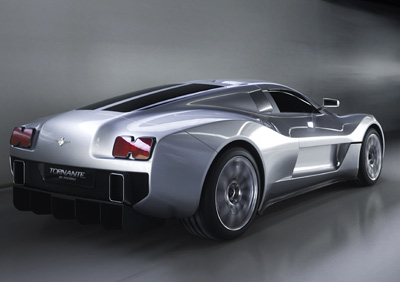
From the rear, the low quarter panels outline the powerful curve
of the roof. Below the waistline, the very visible air diffuser
evokes the research of for maximum downforce.
Drivetrain
The Tornante has the genes of the GUMPERT Apollo and inherits
its impressive V8 biturbo engine. Weighing only 196 kg, the
engine plays a major role in ensuring the ideal weight and the
fascinating driving dynamics of the Tornante. An angle of 90
degree between the two cylinder banks is a sign of a classic
8-cylinder engine.
Starting from the pure block from Audi, the engine is a complete
in-house development. Thus, the manufacturing process contains
among others all the moving parts, air and fuel management,
turbo chargers, charge air-duct and dry sump lubrication. In
the basic version this engine delivers 700 HP. In comparison
to the Apollo, the configuration will be optimized for the Fast
Touring mission. This means more comfort and more suitability
for daily use.
The fully synchronised, automatic six-speed transmission guarantees
efficient utilization of the remarkable energy at the back wheels.
The arrangement of the gears in a longitudinal direction in
the path of travel ensures a very low centre of gravity and
optimum weight distribution.
Extremely short gearshifts up to 40 milliseconds (torque-to-torque)
are provided by the precise TT40e transmission of the Apollo,
where "e" stands for electronic gear system. Gear changes are
faster thanks to rocker switches on the steering wheel. The
Formula 1-type technology promises the ultimate in comfort along
with best driving performance.
|
|