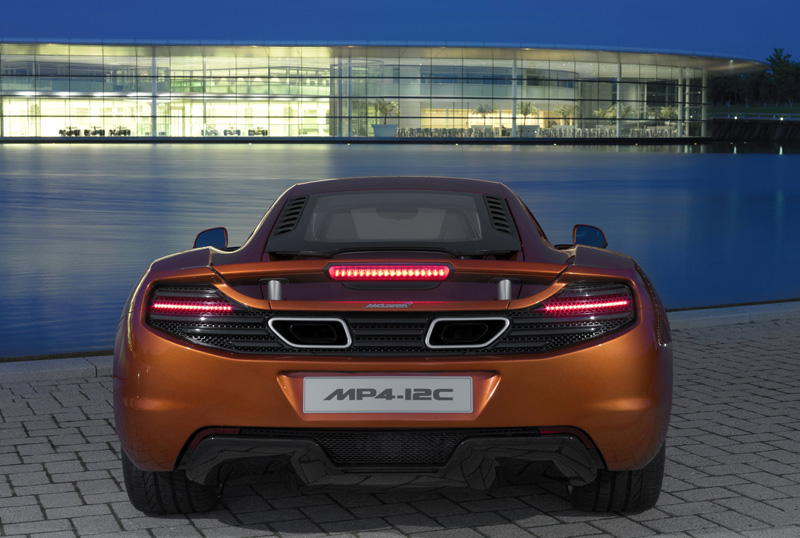
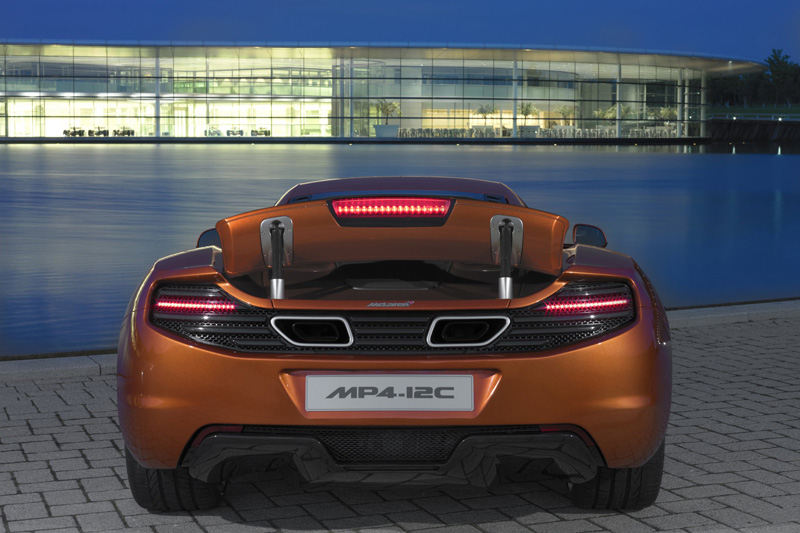
On September 9th 2009 McLaren unveiled their latest roadcar
the MP4-12C. Codenamed the P11 during the years of development,
the MP4-12C is the first complete supercar to emerge from the
McLaren factory since the legendary McLaren F1.
Just like the F1 the new MP4-12C is deeply influenced by Formula
1 race technology. And the name in fact recalls the company's
racing history.
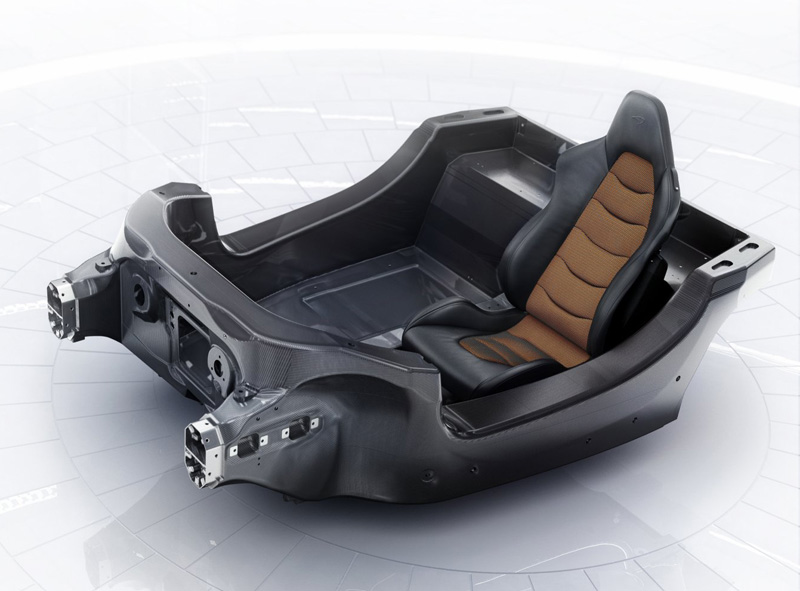
The McLaren MP4-12C is based around a carbon
fiber tub which is both incredibly light, at just 80 kgs,
and immensely strong. As expected from a manufacturer like McLaren,
the MP4-12C is packed with the latest technology and innovative
ideas unique to the car. Brake steer is one such feature, it
is a technology McLaren pioneered on the F1 car back in '97.
Brakesteer helps to reduce understeer on entry to a corner and
improves traction on exit. It works by lightly braking the inside
rear wheel in fast cornering situations. Pre-Cog is another
trick up the MP4-12C's sleeve. This system makes for faster
gear changes by allowing the driver to load up the next gear
by half-squeezing the paddle in preparation for upshifting,
then once the paddle is fully squeezed the change is instantaneous.
The MP4-12C is powered by a twin-tubocharged, 3.8 litre V8 engine
developed in-house by McLaren. The engine, codenamed the 'M838T',
produces around 600 horsepower and 600 Nm of torque. A dry sump
and flat plane crankshaft allow the engine to be placed extremely
low in the chassis thereby lowering the centre of gravity and
improving handling responses. It also features composite cam
covers and intake manifolds, which reduce weight and heat transmission
into the charge air, as well as Nikasil-coated aluminium liners
for further weight reduction.
The power is sent to the rear wheels through two wet clutches
and a McLaren-developed seven speed Seamless Shift dual clutch
gearbox (SSG). This gearbox offers variable settings, from 'normal'
to 'sport', right up to full race mode. In addition an automatic
mode, launch control and winter modes
can be selected, the latter changing all electronic functions
to suit low friction conditions and delivering maximum driver
aid and support.
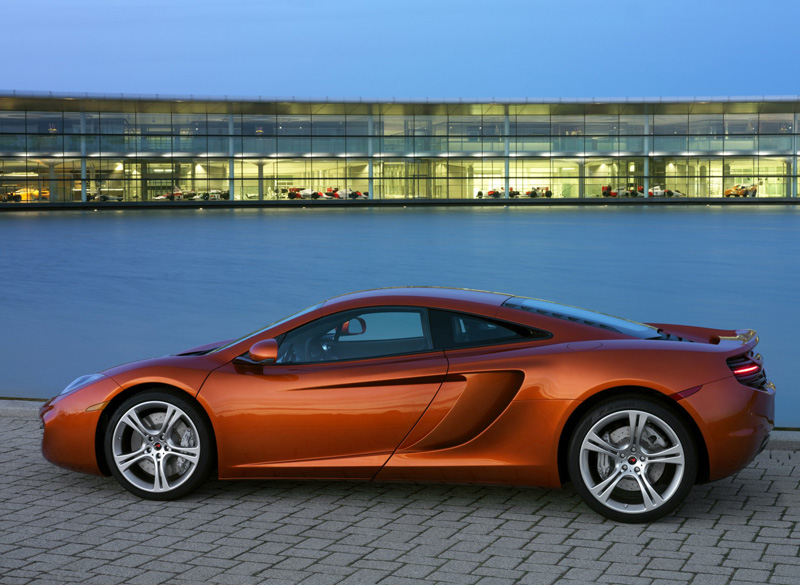
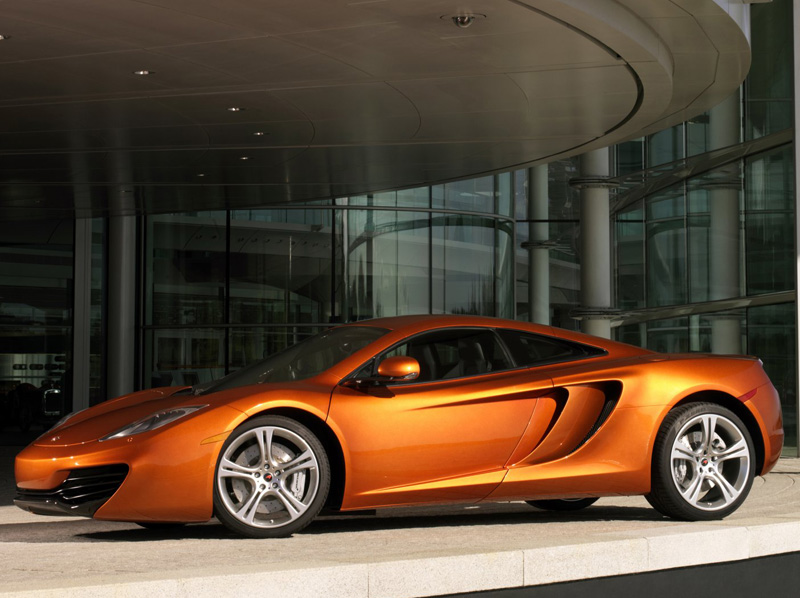
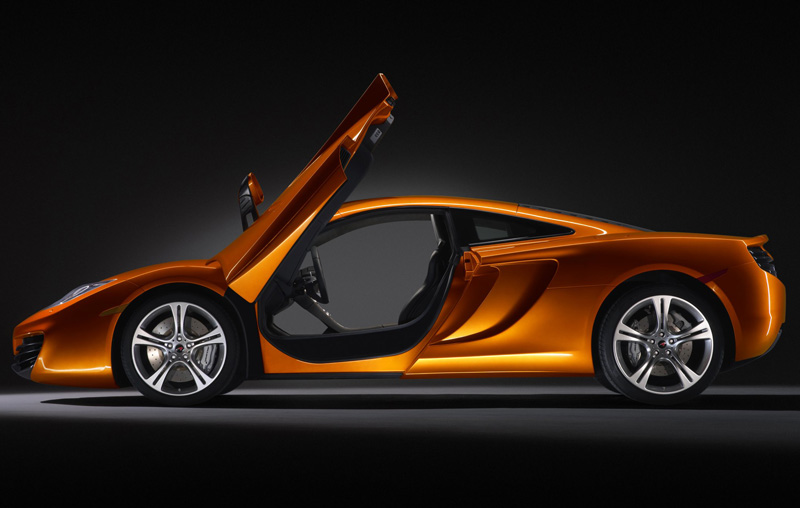
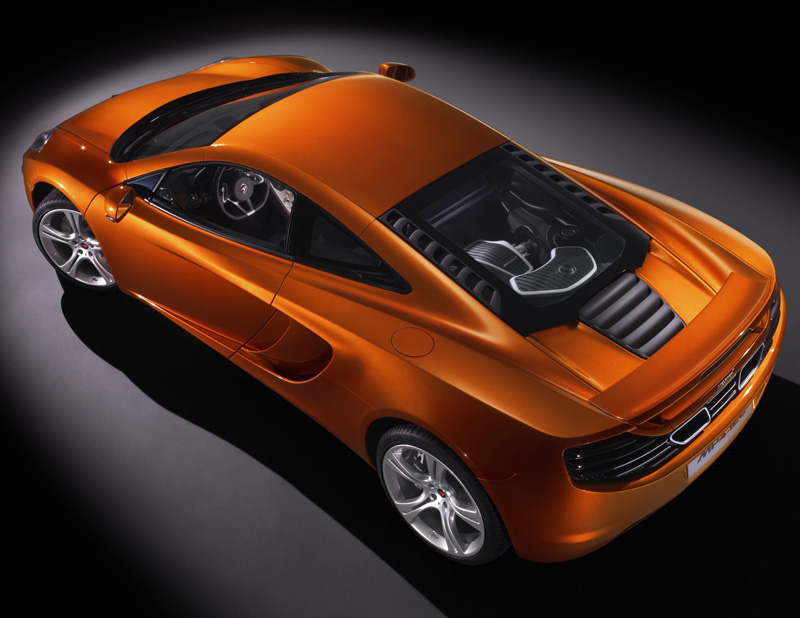
The designers at McLaren have done a great job of giving the
MP4-12C its own identity. It doesn't borrow lines from other
supercars, and the proportions are extremely well balanced.
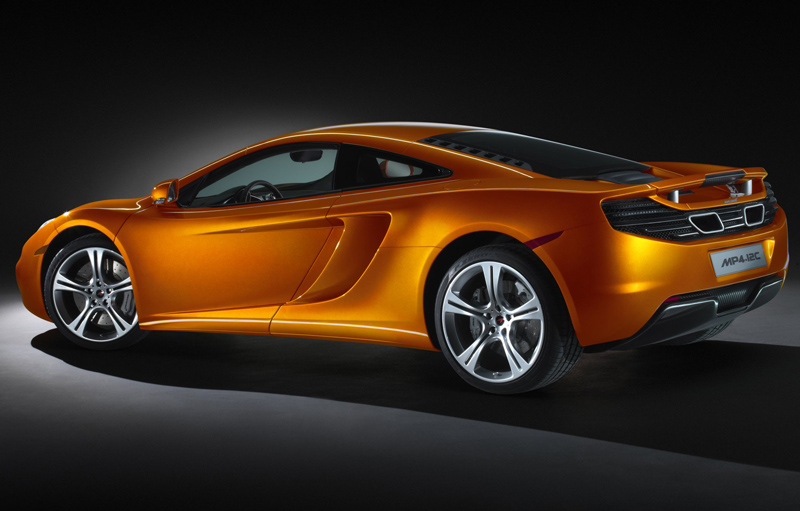
There are very few interuptions to the smooth lines, and the
rear 3/4 view is especially good with the high-mount exhausts
a perfect fit with the rear panel and taillights.
While McLaren's last supercar, the F1 was only sold in extremely
limited numbers, the MP4-12 will be produced in relatively large
numbers. However despite the new approach McLaren are determined
to keep the quality and service at premium levels. "It
doesnt matter whether a customer is spending ten thousand
pounds or a million, it is their money and they rightly expect
to have pride in their purchase and be satisfied with it. Our
goal is to ensure that we exceed customers expectations,"
Said Alan Foster, McLaren's Production Director.
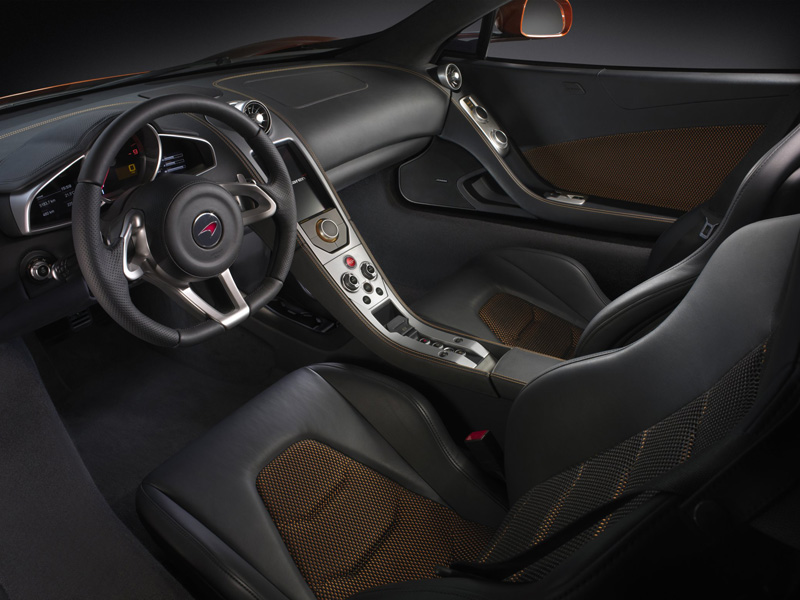
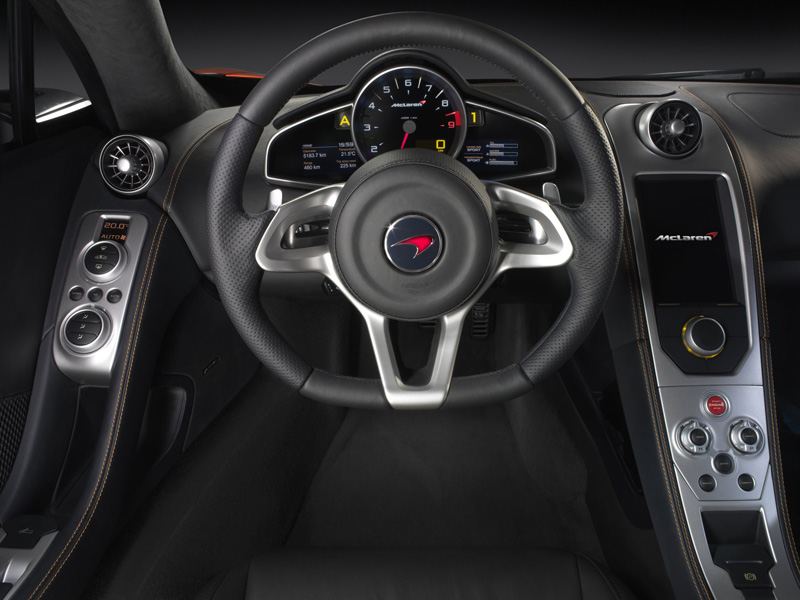
All the parts of the McLaren MP4-12C are bespoke and unique
to this car. Everything from the engine right down to the tailor-made
switches and buttons is pure McLaren: nothing has come from
another manufacturer’s parts bin.
The 12C is powered by a bespoke McLaren ‘M838T’ 3.8 litre, V8
twin-turbo engine producing around 600bhp, driving through a
McLaren seven speed Seamless Shift dual clutch gearbox (SSG).
It is targeting not only new standards for power and performance
in its sector, but also class-leading fuel economy and CO2 emissions;
supported by McLaren’s experience of active aerodynamics to
aid cooling, grip, handling and road holding.
"The 12C is all about performance," said Sheriff.
"And in McLaren, we have a very broad definition of
performance. We don’t just look at the traditional one-dimensional
parameters like top speed, we focus equally on useable measures
such as in-gear acceleration times, braking performance in all
conditions, and efficiency of power delivery combined with the
lowest possible fuel consumption and CO2 emissions. Sure, 12C
is very fast, but it is also the most efficient, most driveable
high-performance sports car in the world."
"In the more subjective areas of road-holding, handling,
comfort, driver involvement and day-to-day usability, McLaren
is achieving new standards for a mid-engined high performance
sports car in this sector," he concluded.
Thorough engineering and market research led to concept development
and a clear decision in favour of a mid-engined two door high
performance sports car. Intensive work was carried out in the
wind tunnel and the driving simulator to ensure that the new
car would inherently have superb dynamic qualities.
Dick Glover, McLaren Automotive Technical Director, was closely
involved with the development of these invaluable tools during
his time with McLaren’s Formula 1 race team.
“There are so many examples of race car process and technology
transfer in the 12C,” claimed Glover. “The car owes much
to McLaren’s experience and success in motor sport. The advantage
of technology transfer is only one element; speed of decision-making
and development, F1 processes and people all make an important
contribution.
"Brake Steer, for example, is a technology we pioneered
on our Formula 1 car back in 1997. It helps to dial out understeer
on entry to a corner and improves traction on the way out. Another
is the Pre-Cog function on the gearshift rocker that effectively
primes the gearbox ready for the next change, ensuring a more
satisfying and faster gearchange. This is a high performance
sports car with race car genes and teamwork at its heart."
Lightness
Weight is the enemy of performance in every area of car design.
It affects acceleration, speed, handling, fuel consumption and
CO2 emissions – everything. McLaren Automotive engineers pursued
weight saving obsessively. For example:
•The Carbon MonoCell not only reduces the weight of the structure
but also allows for the use of much lighter weight body panels.
•The close position of the driver and passenger allows a narrower,
lighter body while giving improved visibility with a clearer
perception of the car’s extremities.
•Brakes with forged aluminium hubs save 8 kg and weigh less
than optional carbon ceramic brakes.
•Lightweight exhaust pipes exit straight out the rear of the
car, minimizing their length and weight.
•Airflow-assisted Airbrake deployment dramatically reduces weight
of the Airbrake activation system.
•Small, compact downsized engine coupled to lightweight compact
SSG minimizes vehicle length, weight and polar moment of inertia.
•Significant weight was pared off the alloy wheels through intensive
Finite Element Analysis of wall thicknesses.
•The engine cooling radiators were mounted at the rear, as close
to the engine as possible, to minimize the pipework, the fluids
contained within them, and therefore weight. They were also
mounted in car line to minimize vehicle width.
"We have spent most of the programme ‘adding lightness’,"
said Mark Vinnels, McLaren Automotive Programme Director. "If
the cost of reducing weight brought performance gains in speed,
handling or economy, we did it. However, if the expense could
deliver improved performance elsewhere we didn’t pursue it.
We never set weight targets as such; we set cost-to-performance
targets and examined everything in this way."
"A good example of this philosophy is that we considered
carbon fibre body panels. They would have reduced weight but
added little benefit as the new one-piece Carbon MonoCell provides
all of the torsional strength the body needs. The costs saved
were used elsewhere for greater weight reduction and efficiencies
overall. This was the holistic approach to weight saving that
we used all the way through development," he concluded.
Design: everything for a reason The McLaren MP4-12C design follows
similar principles to McLaren’s Formula 1 cars, and the legendary
McLaren F1, where everything is for a reason and all lines,
surfaces, and details are designed with a job in mind as much
as styled. This ensures that the 12C communicates its engineering
through its styling and will remain timeless as a piece of automotive
design.
Frank Stephenson, McLaren Automotive Design Director: "Many
sports cars and super cars present an ‘in-your-face’, ‘look-at-me’
image that can become wearing and boorish; the ultimate backhanded
compliment becomes, “…it was of its time”. Great design, however,
is timeless and looks relevant years later. Take the McLaren
F1 as an example. I hope that with the 12C we have produced
a car that looks great today and will still look great in years
to come."
The 12C’s body has been styled to support sector-leading levels
of downforce; downforce that then subsequently contributes to
sector-leading levels of lateral grip and stability. Air flow
has been manically managed to support all performance figures
and light weight targets. For example, placing the radiators
adjacent to the engine keeps the car narrow and reduces weight.
However, this results in a huge challenge of ensuring ample
air flow to the radiators. The result? The large side air scoops
and integrated turning vanes that are dramatic, but purely functional.
No larger or smaller than required.
The designer’s challenge is to then take that styling purpose
driven by engineering aspirations and add personality. That’s
why the air scoops resemble the McLaren logo in form, as do
other features around the car.
Just two ‘pure’ lines flow round the car and, when combined
with the integration of several dramatic convex and concave
surfaces, present a car that looks compact, low and well proportioned.
Light weight and performance are defining philosophies at McLaren.
But outright power alone is of little significance if a car’s
weight saps output or if that power is unmanageable and compromises
the driving experience or results in unacceptable emissions.
Fundamentally, it is critical to keep weight as low as possible.
Increased customer demands for safety and advanced features
all mean that shaving weight is ever more difficult. However,
at McLaren saving weight remains a passion and at the heart
of the McLaren MP4-12C is a carbon fibre composite chassis:
the Carbon MonoCell.
This revolutionary structure is the automotive version of a
McLaren innovation that started with Formula 1 back in 1981
and delivers both weight savings and performance gains. It is
a technology cascade in which McLaren brought carbon composite
technology from the aerospace industry to make the MP4/1 F1
car, the first Formula 1 car to benefit from the strength, weight
and safety of carbon fibre.
McLaren’s Formula 1 carbon fibre technology then offered the
company the opportunity of applying its expertise to road car
applications. The first ever road car to be constructed of this
material was the McLaren F1 produced in 1993, albeit in small
numbers. The F1 was followed by the Mercedes-Benz SLR McLaren
that also shared this rare expertise.
Only a handful of other cars in the market offer such technology
today and all of them lie in the ‘ultimate’ segment. No manufacturer
has brought the advantages of carbon composite technology to
a more affordable sector of the market. But the 12C does, through
engineering passion and a relentless pursuit of efficiency.
So, McLaren did it first with the F1, the world’s fastest car
for many years, then in the highest volume with SLR, which almost
doubled the volume of the next highest produced carbon fibre-based
high performance sports car by selling over 2,100 units. Now,
through revolutionary one-piece moulding of the MonoCell, McLaren
brings a carbon composite chassis down to the ‘core’ category,
where currently only traditional metal structures are offered.
The advantages this technology brings are light weight, high
torsional rigidity, a very strong safety cell, low perishability,
ease of repair and extreme dimensional accuracy.
The 12C MonoCell weighs less than 80 kg. Carbon fibre contributes
to the car’s low overall weight and it forms the structural
basis for the whole car. The tub’s torsional rigidity is considerably
stiffer than a comparable alloy structure.
This inherent lack of flex means the unique front suspension
system, which is mounted directly onto the MonoCell, requires
less compromise for flex of the suspension itself. Therefore,
it is easier to develop the unique balance between fine ride
and precise handling that McLaren has targeted. The MonoCell
also offers greater occupant safety. It acts as a safety survival
cell, as it does for a Formula 1 car.
Carbon composites do not degrade over time like metal structures
that fatigue. One is able to get into a 15-year-old McLaren
F1 and there is none of the tiredness or lack of structural
integrity that afflicts traditional cars that have suffered
a hard life. The 12C will feel as good as new in this respect
for decades.
And in the event of an accident, the light weight aluminium
alloy front and rear structures are designed to absorb impact
forces in a crash and can be replaced relatively easily. Aluminium
extrusions and castings are jig welded into the finished assembly
and bolted directly to the MonoCell. Cars with full aluminium
chassis use their structure to absorb and crumple on impact,
which implies more fundamental damage (and expense) to the whole
structure, including the passenger cell, in a major accident.
McLaren has pioneered a new carbon fibre production process
that allows the MonoCell to be produced to exacting quality
standards, in a single piece, in only four hours, compared to
the dozens of carbon components (and dozens of production hours)
that normally feature in a carbon fibre chassis structure. This
naturally brings huge efficiency and quality benefits. The MonoCell
project is managed by Claudio Santoni, McLaren Automotive Body
Structures Function Manager.
“It was clear that we needed to develop a car with a carbon
fibre structure. After all, McLaren has never made a car with
a metal chassis!” said Santoni.
“The whole 12C project is based on the concept of the MonoCell.
This means that McLaren can launch into the market with greater
performance than our rivals and a safer structure. To put it
into perspective, if the costs and complexity of producing a
McLaren F1 carbon fibre chassis are taken as a factor of 100,
the 12C chassis production costs are reduced to a factor of
seven or eight, without degrading the strength or quality of
the carbon fibre structure. And this step-change in technology
could make its way into more mainstream cars,” he concluded.
Getting the production process right is the result of five years
of extensive research. Now that the process is perfected, it
allows McLaren to produce the MonoCell repeatedly at very high
quality.
“Not many people in the automobile world work to standards
demanded by the aerospace industry,” claimed Mark Vinnels,
McLaren Automotive Programme Director.
"Our ability to analyse and predict the performance
of carbon fibre is in line with aerospace technology and is
truly world class, particularly in the sense of predicting failure,
which is obviously key in managing crash events and passive
safety.
"We can now predict failure levels at individual ply level
in the carbon composite and the results are absolutely correlating
with what we predicted," he concluded.
The finished MonoCell emerges in one piece and this new process
could revolutionise car design. It avoids the need to bond different
parts to make the whole structure, as with all other carbon
fibre cars. It is hollow, saving further weight, and the integrity
of production ensures the location of suspension and ancillaries
is accurate to the finest of tolerances.