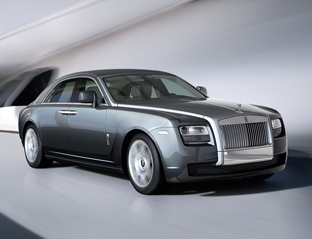
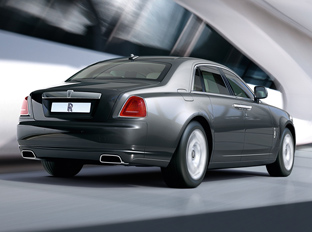
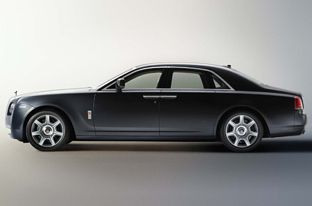
The 2010 Rolls-Royce Ghost, which is based on the Rolls-Royce
200EX concept is powered by a brand new 6.6 litre turbo
charged V12 engine unique to Rolls-Royce. This engine develops
563 bhp @ 5250 rpm, and 780 Nm (575 lb-ft) of torque @ 1500
rpm. And despite the massive overall weight of nearly three
tons, this powerplant allows for a 0-60 mph time of 4.7 seconds
and a governed top speed of 155 mph. The engine is combined
with an 8-speed automatic ZF gearbox.
Rolls-Royce Director of Engineering, Helmut Riedl said of the
vehicle, "First and foremost Ghost is a Rolls-Royce.
This means that despite its extraordinary performance figures
it has been engineered for effortless composure and refined
power delivery. This is illustrated by the significant levels
of low down torque available which makes pulling away very smooth
and for an exceptionally relaxed driving experience."
Riedl continues, "Rolls-Royce power is entirely different
to anything else in the automotive world. It is delivered free
from stress and exertion but at the same time must engage the
driver. Ghost is about fingertip control while still enjoying
a dynamic connection with the road. Equally passengers need
to be cosseted from the physical sensations of acceleration,
braking and cornering. Our chassis set up keeps Ghost stable
and flat, preventing it from wallowing or pitching in the corners
or imposing undesirable forces on those inside."
The Rolls-Royce Ghost uses an adaptive air suspension system
on all four corners. The fully integrated system allows each
of the Ghost’s dynamic handling systems to work together in
harmony, providing the optimum levels of refinement and comfort
at all times.
The vehicle acoustics also play a vital role in creating the
authentic Rolls-Royce environment. The engine, exhaust and even
tire noise have been engineered to be inaudible as far as possible,
both internally and externally.
Rolls-Royce Motor Cars Chief Executive Officer, Tom Purves,
said, "Ghost is not about a single superlative but rather
a careful blend of attributes. A Rolls-Royce should carry its
power with grace, agility and refinement and this is never achieved
by a focus on outright performance. Mastery comes in creating
a balance and having driven the Ghost again recently I can say
confidently that our engineering team has achieved this in fine
style".
Similar and related vehicles:
2005
Rolls Royce Phantom
2006
Rolls Royce Phantom Black
2008
Phantom Drophead Coupe 
Rolls-Royce 200EX Concept
Rolls-Royce 100EX Concept
Rolls-Royce 101EX Concept
Rolls-Royce press release:
" Simplicity is the hardest design principle to follow."
Ian Cameron, Chief Designer
Ghost’s flowing lines are dominated by its majestic ‘Yacht Line’
styling. Large, uninterrupted surfaces flow between finely sculpted
horizontal lines that provide definition. Together, the upward-sweeping
sill line and low-cut roof create a powerful profile, almost
as though the cabin has been pushed toward the rear. Powerful
shoulders and flanks draw in sharply as they flow from the rear
wings to the tail lights, while touches such as the optional
chromed exhausts hint at Ghost’s more dynamic nature.
While incorporating classic Rolls-Royce design cues – the elevated
prow, long bonnet, short front overhang, sharply raked A-pillar
and elegant tail – Ghost exudes an informal aura. Contemporary
touches include self-righting wheel centres and the Xenon headlamps
that frame the latest evolution of the Rolls-Royce grille. Here
the sides of the intake have been curved inwards and the vanes
set back into the opening. “We wanted this to be less reminiscent
of the traditional Parthenon style and more like a jet intake,”
says Ian Cameron. A contrasting Silver Satin finish (introduced
on 200EX) is an option for the bonnet, grille and windscreen
surround. The finish is achieved by setting silver metallic
paint under a layer of lacquer, giving a flawless matte finish.
The central principle of delivering simplicity out of complexity
runs throughout Ghost. Everything is designed, engineered and
crafted to enhance the drive and ride experience, not to complicate
it.
“Ghost is as refined and cosseting as anything this marque has
ever produced.” Charles Coldham, Interior Designer
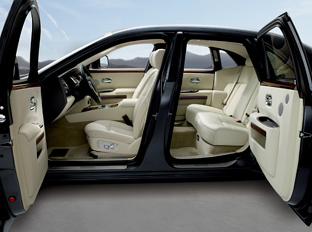
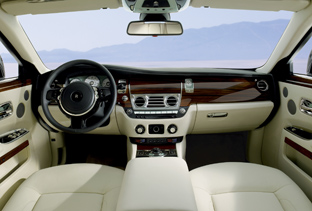
Inside Ghost, the interior design team has come up with a contemporary
ambience while staying true to Rolls-Royce Motor Cars’ traditions
of fine materials and peerless comfort. There are elegant, frosted
lamps and chrome door handles, traditional violin key switches
and eyeball air vents, frosted white dials and refined instrumentation.
Deep-pile carpets can be complemented by optional lambswool
floor mats for a truly luxurious feel. Ghost is entered through
substantial doors. Housed within the front doors are integrated
Teflon-coated umbrellas. The rear doors are traditional, rear-hinged
coach doors, opening to a generous 83 degrees. Once the passenger
is inside, these doors can be closed at the touch of a button.
The interior space is filled with natural light, enhanced by
the optional Panorama Sunroof, which extends from the front
into the rear compartment. Four-zone automatic air conditioning
can be individually tailored to each passenger’s requirements,
with separate controls for front and rear. Automatic air recirculation,
condensation prevention and solar compensation are delivered
through classic chromed eyeball vents controlled via organ-stop
plungers.
Within Ghost’s ample doors and high shoulder line, occupants
feel serene, cosseted and safe. In the rear, the intimate ambience
of the lounge seat is emphasised by its position behind the
C-pillar, heightening the sense of privacy. The informal seating
creates a convivial environment, its slight curve allowing you
to turn more easily towards the person next to you. Its elevated
position gives a clear view past the electronically retracting
Spirit of Ecstasy to the road ahead.
Individual lounge seating is offered as an alternative to the
standard lounge configuration. This allows the addition of a
massage function and also perforated leather for a cooling stream
of air from the seat surface. Auxiliary rear climate control
allows the passenger to regulate the temperature of the air
on their side of the car, without intrusion on the other. A
cool box with interior illumination and integrated champagne
glasses is also available.
Veneered picnic tables are another option, incorporating the
finest leather and veneers matched to the rest of Ghost’s interior.
Fitted to the rear of each front seat, these tables are a traditional
Rolls-Royce design cue and finished with a veneered surface
with leather-covered backs.
“Ghost is designed to be an escape from the outside world.”
Alan Sheppard, Interior Designer
Enhancing the Ghost ambience is an audio system delivering an
exquisite experience. 600 Watts of sound are delivered through
a 10-channel amplifier and 16 speakers, including two floor-mounted
subwoofers. USB and auxiliary inputs allow for the integration
of external audio devices and a 12.5 GB hard drive enables storage
of music files from USB or CD player sources.
Available as an option with both seating arrangements is Theatre
Configuration, which allows all settings that do not directly
affect the driver to be controlled from the rear seat. The functions
are displayed on two 9.2in LCD screens in the back of the front
seats; these can be angled to suit the viewers by a central,
armrest-mounted, rotary controller. The screens can be regulated
independently of each other and the entertainment can also be
listened to individually with most headphones. A six-disc multi-media
changer, mounted in the glove compartment, is fitted as part
of this option.
ENGINEERING A BENCHMARK
“The balance of refinement and dynamic ability is astonishing.”
Helmut Riedl, Engineering Director
When considering a Rolls-Royce car it is usual to think of wood,
leather and chrome, but the company has its roots in engineering.
The refinement of its end product stems from its engineers’
desire to get the smallest details correct. Long before the
interior items are prepared, experts are working to ensure that
the chassis components, power trains and bodywork are operating
in fluid harmony. This is a world where welds are an art form
and craftsmanship exists at a nano level.
Ghost is built around a steel monocoque body, which means there
is no separation of chassis and body. The advantage of this
construction is a reduction in exterior dimensions while preserving
interior space. Consequently while Ghost is 400mm shorter overall
than the Phantom saloon its interior space is comparable.
The body has been engineered with a double front bulkhead to
help insulate the interior from engine noise. It is constructed
from steel sections and then wrapped in steel panels, which
are brazed by hand. This allows a near-seamless join, which
is then sanded by hand until it is perfect. In total, Ghost’s
frame contains 4.9m of seam weld and braze and 6,988 spot-welds.
The bonnet and windscreen surround are then honed from aluminium.
“A Rolls-Royce should be graceful in every way: the way it handles,
feels and brakes.” Helmut Riedl, Engineering Director
Ghost rides on a bed of air. Double-wishbone front suspension
and multi-link rear suspension work with an intelligent, four-cornered,
air-suspension system and electronic variable damping to deliver
the refinement that has been associated with Rolls-Royce for
more than 100 years.
The new air suspension system in Ghost is so sensitive that
it can detect even the smallest of changes. For example, it
will sense the movement of a single rear passenger from one
side of the seat to the other and compensate accordingly. A
complex computer system reads multiple inputs from sensors around
the car; the dampers alone make individual load calculations
every 2.5 milliseconds. This ensures not only perfect comfort
but also precise steering and dynamics for the driver. The air
suspension system also incorporates a lift and kneel function,
raising or lowering Ghost by 25mm.
Ghost also has a series of complex electronic aids to keep it
composed on virtually any surface. These include Anti-Roll Stabilisation,
Dynamic Brake Control and Dynamic Stability Control, including
Dynamic Traction Control and Cornering Brake Control. These
individual technologies work together under dual Integrated
Chassis Management systems, meaning that even when subjected
to a vigorous test Ghost remains perfectly poised. Its handling
and safety systems operate as one, imperceptibly to the driver
and passengers, to maintain optimum contact with the road in
any condition.
“Our challenge,” says Engineering Director Helmut Riedl, “has
been to preserve the prerequisite levels of comfort while delivering
the most modern, dynamically interesting drive ever in a Rolls-Royce.”
Ghost is powered by a brand new, 6.6 litre twin-turbo V12 engine,
unique to the model. Featuring direct injection, it produces
563bhp – enough to propel Ghost from 0-60 mph in just 4.7 seconds*
and on to an electronically governed top speed of 155mph. With
780 Nm of torque available at just 1,500rpm, delivery of power
is immediate and extremely smooth.
Power is transmitted through an eight-speed, shift-by-wire,
automatic ZF gearbox. What this achieves is a feeling of endless,
surging power, which is illustrated by the power reserve gauge
on the fascia, replacing the more common rev counter. The new
powertrain delivers this performance while emitting just 317g/km
of CO2. Fuel consumption is 20.8 mpg / 13.6 l/100km.*
Safety remains paramount and the very latest technologies are
used in Ghost. Side-impact beams in the front and rear doors
combine with progressive rear crumple zones to absorb impacts.
The Advanced Crash and Safety Management (ACSM) system takes
measurements 2,000 times per second from sensors located around
the vehicle. The ACSM uses this information – in conjunction
with the engine and chassis management systems – to judge which
safety features to deploy in which areas in the event of an
accident. If necessary, ACSM will activate – among other things
– seatbelt pre-tensioners and all encompassing airbags surrounding
the cabin, creating a safe zone for all occupants.
A MODERN ROLLS-ROYCE
Ghost is the most powerful car that Rolls-Royce Motor Cars has
ever produced. However, Rolls-Royce power is delivered in a
very different manner to other cars. It arrives in an elegant,
cosseting way that some have described as being designed to
lower the pulse, not raise it.
The principle of simplicity extends to the act of driving Ghost.
The host of complex engineering software and technologies beneath
the surface serve to make driving easier and more enjoyable,
not to intrude or confuse.
“Nothing should distract from the pleasure of driving Ghost.”
Helmut Riedl, Engineering Director
Ghost is more driver-focused than any Rolls-Royce car before
it. The driver sits in a slightly elevated position behind the
wheel, described as the authority position. This makes the view
of the road much clearer. The fascia has been kept deliberately
clear; it is spacious in design and has an intuitive layout.
The controls are neatly sculpted, with the more important functions
emphasised by accents of chrome. The soft light of the instrument
panel glows through the familiar black-rimmed steering wheel,
which in turn employs a number of violin keys as well as an
ergonomic roller-ball control.
The control centre display is concealed behind a veneered panel
until its services are called upon. All features such as satellite
navigation, telephone, communication and entertainment functions
are displayed here and managed via a central rotary controller,
flanked by quick-access buttons on the front centre console.
The optional driver assistance systems and technologies in Ghost
are notable for their discretion and ease of operation. From
the moment the driver approaches the car, optional Comfort Entry**
allows easy access, unlocking the doors when the key fob is
within 1.5 metres and the cool chromed handle is grasped. Once
you are in the car, voice control allows you to select from
the control systems menus without using the central controller.
For ease of manoeuvring, cameras located around the car serve
a number of purposes. Rear, front side and top view cameras
can combine to give a fish-eye view at blind junctions or provide
ground images with obstacle recognition and reverse path prediction
when parking.
Positioned discreetly within the grille is a Night Vision**
camera. When activated, this safety feature works with Pedestrian
Recognition to detect objects up to 300 metres away and display
them on the central screen in the dash. The car’s control system
receives infrared heat images from the camera and, taking into
account the car’s speed and direction, classifies them to assess
imminent danger. It then determines what action, if any, needs
to be taken and if necessary displays a warning to the driver.
The Head-up Display relays crucial information such as speed
or navigation directions onto the windscreen directly in front
of the driver. This information is visible only to the driver
and can be tailored to show only the details required and at
a position suitable to the driver.
Lane Departure Warning** alerts the driver should the car start
to drift out of its current lane. When activated, it uses an
integrated camera, located just in front of the rear view mirror,
to monitor road markings and the vehicle’s position. The driver
is warned by a discreet vibration through the steering wheel.
If the driver uses the directional indicators before and after
the lane change, the wheel will not vibrate.
High Beam Assistance** automatically manages the operation of
dipped and main beam lights while driving at night. When activated,
the same camera used by the Lane Departure Warning system monitors
the light from any source at the front of the vehicle and automatically
dips or raises the headlights accordingly. Adaptive, directional
headlights also improve illumination of the road ahead and adapt
to the road conditions, be they rain or fog or simply when the
car is making a turn.
Active Cruise Control with Stop & Go** creates a relaxing driving
experience, particularly on long cruising journeys, as action
is not required when the car ahead speeds up or slows down,
even when coming to a standstill. Active Brake Intervention**
also allows hill descent at a constant speed and the car’s Curve
Speed Limiter communicates with the car’s Dynamic Stability
Control systems to reduce speed on bends if safety and comfort
may be compromised.
LEGENDARY CRAFTSMANSHIP
Rolls-Royce has a reputation for producing cars that transcend
the mere automotive. There is a magic attached to the name,
which stems in part from exquisite attention to detail and the
fine materials used throughout.
Passing through 60 pairs of hands, the production process involves
more than 2,000 individual operations and takes at least 20
days to complete.
“We don’t just paint our cars, we strive to create an incredibly
deep, flawless shine.” Lisa Taylor, Paint Associate
Ghost shares the same paint shop as Phantom and spends seven
days being painted and polished to perfection. Five stages are
required for the Ghost body. First a phosphate electro-coat
is applied to protect against corrosion, then a layer of primer,
a colour coat and finally two coats of clear lacquer. The body
is hand-sanded between each layer and once the final coat is
applied it is hand-polished for five hours.
Ghost is available in 12 exterior colours, each of which can
be contrasted by the optional Silver Satin bonnet.
Flawless leather is an absolute requirement for the interior
of a Rolls-Royce. For this reason, our leather is sourced from
bulls raised in pastures free of barbed wire, ensuring that
there are fewer imperfections in the leather. Any other marks
are carefully avoided by our skilled laser cutters. At least
eight hides are used for an interior, and to ensure colour consistency,
each hide comes from a batch dyed at the same time. The hides
are drum-dyed rather than painted, ensuring that the colour
permeates right through the leather. The process also means
the leather remains much more supple, preventing cracking or
squeaking and ensuring durability and longevity. All seats and
interior panels are hand-stitched, using traditional upholstering
techniques by those most skilled at their craft.
The natural beauty of the veneers in Ghost is brought to life
by the skill of dedicated craftsmen and women. The natural burrs
and grains are chosen for their intricacy and interest: veneer
specialists choose only the finest logs from which these very
thin cross sections are taken. Only veneer from one tree is
used in any car. This ensures not only that the grain matches
throughout the interior, but that each area ages and colours
at the same pace. The parts are milled and sanded by hand before
being coated with five layers of lacquer for protection and
a mirror-like shine.
|