The
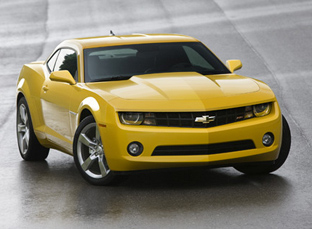
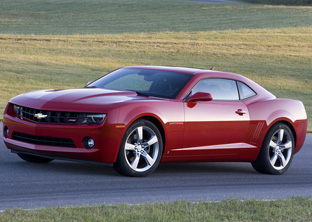
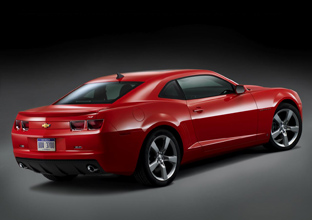
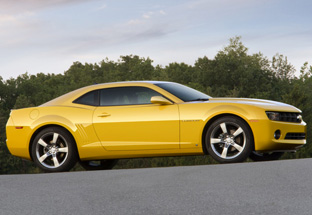
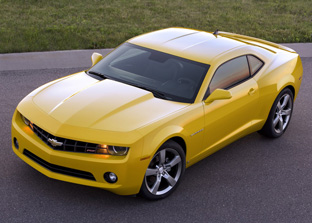
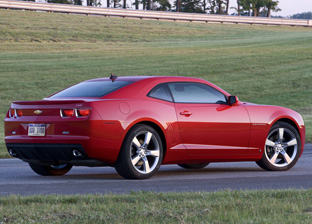
long-awaited 2010 Chevrolet Camaro marks a return of one of
GM's most iconic models. Unlike the previous 4th generation
Camaro which was an evolution model developed from the prior
generations, the 5th generation Camaro is designed from a clean
slate.
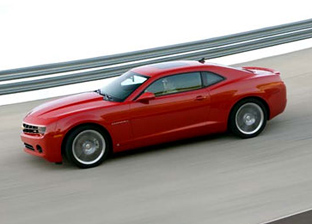
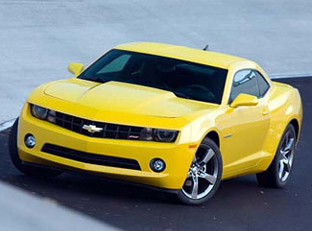
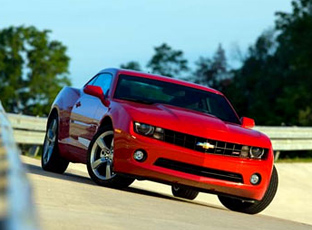
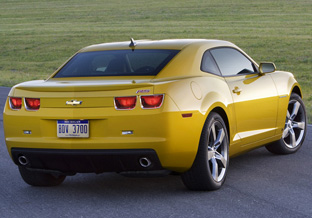
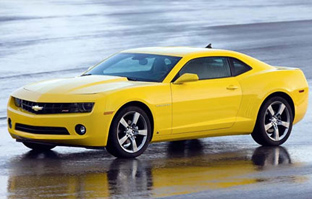
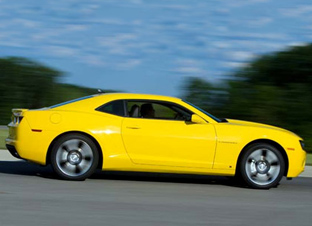
The retro styling is modeled on the original 1960's muscle car.
But underneath, the Camaro is all-new - aside from the powertrain.
Powering the 2010 Chevrolet Camaro is a choice of engines, including
a 300 horsepower 3.6 litre V6, and a 422 horsepower 6.2 litre
V8. Coupled to the engine is a choice of manual or automatic
6-speed transmissions driving the rear wheels.
Weighing in at around 1700 kgs (3750 lbs) the 5th generation
Camaro is not a lightweight sports car. Although the 52/48 front/rear
weight distribution should help improve the handling. As will
fully independent suspension. The 2010 Chevrolet Camaro also
features a StabiliTrak stability control system to keep the
back end in line. For top spec models the 210 Camaro is equipped
with Brembo performance brakes.
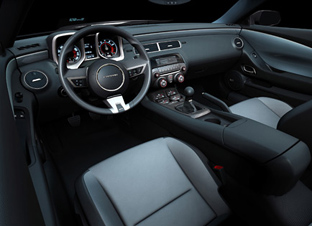
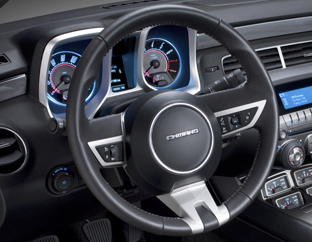
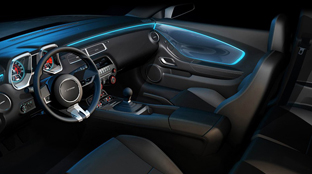
Unfortunately the interior of the fifth generation Chevrolet
Camaro is not as nice as the stunning exterior. Vast expanses
of black plastic are an eyesore, and while the distinctive gauge
cluster, blue LED lighting and center console mounted ancillary
gauges are styled to be reminiscent of the original 1960s Camaro,
they somehow don't quite work in a 21st century car.
However, despite the disappointing interior, the 2010 Camaro
should prove to be a worthy competitor to the Ford Mustang and
Dodge Challenger. Even if it was a little late to the party.
Similar and related vehicles:
Ford Mustang GT
Ford Mustang GT-R Concept
Ford Mustang SVT Cobra R
Ford Mustang Shelby GT500
Ford Mustang Shelby GT500KR
Ford Mustang Shelby GT
Ford Mustang Shelby GT-H
Dodge Challenger SRT8
Chevrolet Corvette ZR1 
Chevrolet Corvette ZO6
Chevrolet Corvette Convertible
Chevrolet Corvette C6
Chevrolet Camaro Z28
Related Retailers:
- Corvette Guys
Below is the press release for the 2010 Chevrolet Camaro.
Built on GM’s new, global rear-wheel-drive architecture, the
Camaro is offered in V-6- powered LS and LT models, as well
as the V-8-powered SS. All models and powertrain combinations
include fuel-saving six-speed transmissions.
“Camaro delivers all of the things that make Chevrolet such
a revered, global brand,” said Ed Peper, GM North America vice
president, Chevrolet. “It competes with the world’s best sports
cars and does so with styling, fuel economy and value our competitors
simply can’t match.”
Advanced powertrain technologies, including engines with direct
injection and Active Fuel Management, enable a satisfying balance
of exhilarating performance and good fuel economy.
“The new Chevrolet Camaro delivers a thoroughly modern, advanced
package of performance, comfort and technology,” said Peper.
“It’s a sports car for a new generation of enthusiasts that
doesn’t forget the heritage that helped make the original a
cultural icon. That is no small feat and it took a worldwide
commitment to achieve it.”
Indeed, the 2010 Camaro exemplifies GM’s global development
process. The design concept originated in the United States;
engineering was directed by GM’s global rear- wheel-drive team
in Australia; validation was conducted on roads around the world
and assembly will take place at GM’s award-winning Oshawa facility
in Canada.
Product highlights include:
• Sleek styling with contemporary cues and 10 available exterior
colors
• LS and LT models offered with an advanced, 3.6L direct-injected
V-6 engine with variable valve timing and a choice of six-speed
manual or automatic transmissions
• SS model offered with 6.2L V-8 – including fuel-saving Active
Fuel Management on automatic-equipped combinations – and a six-speed
manual transmission
• Four-wheel independent suspension system, including a 4.5-link
rear suspension
• Variable-rate power steering with the rack mounted forward
of the front axle for greater driver feel
• Four-wheel disc brake systems standard on all models, including
four-piston Brembo calipers on SS models
• StabiliTrak stability control system and traction control
standard on all models
• Competitive/Sport modes for the stability system offered on
SS models, including launch control on SS models equipped with
the six-speed manual transmission
• Family of 18-, 19- and 20-inch wheels
• Detailed interior with heritage-inspired design, excellent
attention to detail and available ambient lighting via LED light
pipe technology
• Robust body structure and exceptional build quality
• Six standard air bags, including head curtain side-impact
air bags and front seat- mounted thorax side air bags
• RS appearance package available on LT and SS, including HID
headlamps with integrated halo rings, spoiler, specific taillamps
and 20-inch wheels
The new Camaro also has technologies that enhance performance,
comfort and convenience, including:
• Bluetooth phone connectivity
• Premium Boston Acoustics audio system
• USB connectivity
• Ultrasonic rear parking assist (late introduction)
• Remote vehicle starting system
• OnStar
• XM Satellite Radio
Additionally, details such as frameless door windows with automatic
indexing glass contribute to the overall feeling of quality,
substance and technical prowess.
Design details
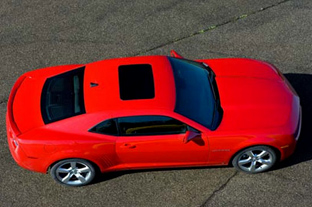
With a design that is very faithful to the original concept,
the 2010 Camaro is a 21st century sports car that acknowledges
its heritage. A long front dash-to-axle and short rear deck
give the Camaro classic proportions, while a sleek windshield
profile, wheels pushed to the corners and muscular fender forms
are modern elements that reinforce its advanced engineering
– and give the car a decidedly aggressive stance.
Elements such as a forward-V shape at the front of the car and
“gills” in the rear quarter panels are distinctly Camaro cues,
as are the broad rear fender “shoulders.” Those elements make
the new Camaro instantly recognizable, but their execution is
smoothly integrated into the contemporary exterior form. A family
of large, 18-, 19- and 20-inch wheels also contributes to the
Camaro’s modern appearance.
“The new Camaro is just that – new,” said Ed Welburn, vice president
of GM Global Design. “We acknowledge the nameplate’s strong
heritage in the design, but recognize that keeping this modern
sports car relevant meant more than simply honoring a classic
car. The line forms, stance and overall execution are consistent
with other new Chevrolets.”
A well-executed balance of heritage, modern design and attention
to detail also characterizes the Camaro’s interior. A pair of
deeply recessed instrument binnacles that
feature round gauges in square housings is a nod to classic
Camaros, while an available ambient light package offers advanced
LED light pipe technology to give the cabin a distinctive and
inviting glow. Cloth upholstery is standard; heated leather-appointed
seats are available.
Details such as large, chrome-trimmed controls, low-gloss surfaces
and premium fabric or acrylic appliqués convey a richness that
is unprecedented in previous Camaro models – and challenge its
contemporary competitors. More great detail is evidenced in
the available center-console gauge cluster, which takes its
cue from a similar option on 1969 Camaros. It displays oil temperature,
oil pressure, state-of-battery and transmission fluid temperature,
all highlighted with modern LED backlighting.
Powertrains
An advanced, efficient 3.6L direct-injected V-6 with variable
valve timing is standard on LS and LT models. Direct injection
technology helps the engine deliver more power through increased
efficiency, while maintaining fuel economy and lowering emissions.
That means less fuel is consumed and lower emissions generated
– including a 25- percent drop in cold-start hydrocarbon emissions.
The Camaro’s 3.6L engine also employs variable valve timing
to optimize performance and fuel economy across the rpm range.
It is rated at an estimated 300 horsepower (224 kW) and 273
lb.-ft. of torque (370 Nm). A six-speed manual transmission
is standard with the 3.6L engine; a Hydra-Matic 6L50 electronically
controlled six-speed automatic, with TAPshift control, is available.
The high-performance Camaro SS is equipped with a powerful 6.2L
V-8, with a choice of a six-speed manual or six-speed automatic
transmission. Standard, manual transmission-equipped models
receive the LS3 engine, estimated at 422 horsepower (315 kW)
and 408 lb.-ft. of torque (553 Nm). The LS3 debuted on the 2008
Corvette and uses high-flow cylinder heads based on the Corvette
Z06’s LS7 engine to enable great low-end torque and high-rpm
power. It is paired with a TR6060 six-speed transmission.
A new, L99 V-8 engine is used on automatic transmission-equipped
SS models. It is based on the LS3 and carries all of its high-performance
design features, but also includes GM’s fuel-saving Active Fuel
Management feature. It enables the engine to run on only four
cylinders during light-load driving conditions, such as highway
cruising, to improve fuel economy. The V-8 is estimated at 400
horsepower (299 kW) and 395 lb.-ft. of torque (535 Nm); and
it is matched with a Hydra-Matic 6L80 six-speed transmission.
This combination delivers an estimated 23 mpg on the highway.
Body structure and chassis
The 2010 Camaro is built on GM’s global rear-wheel-drive architecture,
with a strong body structure that enhances safety, quietness
and handling. World-class build quality and attention to detail
are enabled by features including one-piece body side stampings
and very precise tolerances between body panels.
Front and rear independent suspensions are mounted to the rigid
chassis, including a multi-link strut arrangement in the front
with a direct-acting stabilizer bar and a double ball-joint
configuration; and a unique, 4.5-link rear suspension that is
double-isolated from the chassis for smoother, quieter driving
experience.
Camaro offers two suspensions. LS and LT models receive an FE2
(sport) suspension, while the SS receives the FE3 (performance)
suspension, including a lower ride height. Each is tuned to
match the performance capabilities of their respective powertrains,
as are their wheel-and-tire combinations.
A variable-rate rack-and-pinion power steering system mounts
the rack forward of the front axle, for more direct action,
an enhanced feeling of driver feedback and better weight balance.
Brakes and chassis control
Four-wheel disc brakes with ABS are standard on all models.
LS and LT models receive single-piston calipers all around,
with mass-reducing aluminum rear calipers. SS models have larger
rotors that are acted upon by four-piston, aluminum Brembo calipers
at all four corners. They are designed to stand up to the severe
use encountered on road-race tracks, delivering excellent feedback
and pedal feel, as well as fade-resistant performance during
racing.
GM’s StabilTrak electronic stability control system is standard
and incorporates traction control. The system on SS models includes
Competitive/Sport mode that is adjustable for performance driving,
such as on a racetrack; it also includes a Launch Control feature
on SS models with the manual transmission. It enables quicker,
more consistent takeoffs during performance driving.
Safety
Designed to protect occupants before, during and after a crash,
the Camaro offers a comprehensive system of safety features
– starting with a robust body structure and integral safety
cage around the passenger compartment. High-strength steel and
ultra high-strength steel are used in key areas throughout the
structure.
Safety technologies integrated in the Camaro include:
• Driver and front-passenger dual-stage air bags
• Driver and front-passenger seat-mounted thorax side-impact
air bags
• Head curtain side-impact air bags for front and rear seat
occupants
• Front seat safety belt load limiters and pre-tensioners
The front passenger detection system senses children and small-stature
adults and suppresses air bag deployment when appropriate.
Standard OnStar service assists after a crash. With OnStar’s
Advanced Crash Response System, the vehicle automatically sends
a signal to OnStar for assistance, even if the air bags don’t
deploy.
|