Aircraft
> Concept Aircraft
Concept aircraft play an important role in advancing the aerospace
industry. They can be used to test aerodynamci theories, trial new
systems or just push boundaries. Listed here are some of the more
unusual concept aircraft which have taken to the skies.
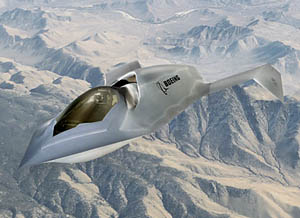
Boeing Bird of Prey
The Bird of Prey project cost $67 million, and the
project was classified from 1992 to 1999. The first
flight was in 1996. The Bird of Prey helped to develop
stealth technology for the US airforce. Although
the aircraft itself was never commisioned for production. |
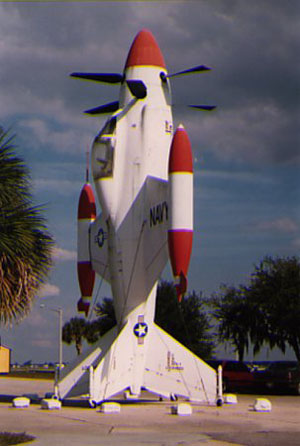 Lockheed XFV-1
The Lockheed XFV-1 is a 'tailsitter' VTOL (Vertical
Take-Off and Landing) aircraft. It was created by
the US Navy who were looking for ways to improve
ship defense by equipping merchant ships with vertical
take-off aircraft. The XFV-1 used the Allison YT40-A-14
engine to drive two 16 ft counter-rotating three-bladed
Curtiss-Wright propellers with electric pitch control.
The XFV-1 was fitted with a conventional landing
gear to make its first horizontal flight in March
1954. A total of 27 level flights were made. Control
in hover was very poor. No vertical take-offs or
landings were ever attempted. |
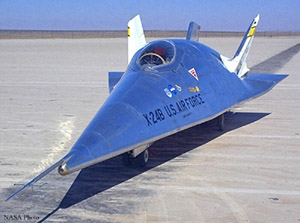 Martin X-24B
The rocket powered X-24B, which first
flew in August 1973, was developed from the experiences
gained through the 28 flights of the X-24A. The
X-24B made 10 glide and 26 powered flights before
the program ended in 1975, having validated the
lifting-body aircraft concept. |
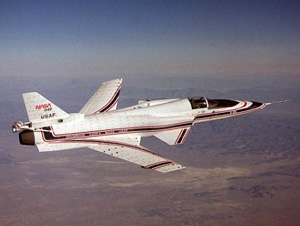 Grumman X-29
Two X-29s were built and flown at the NASA Ames-Dryden
Flight Research Facility, Edwards, California. The
X-29 was used as a technology demonstrator to investigate
advanced designs and technology. The extensive program
was conducted from 1984 to 1992 and engineering
data gathered is useful for the design and development
of future aircraft. |
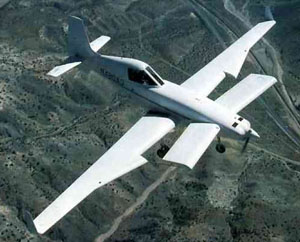 ATAC Predator 480
The Predator 480 was an unconventional
high performance crop-duster. Advanced Technology
Aircraft Company contracted with Scaled Composites
to design and build a proof-of-concept crop-duster.
Designed by Burt Rutan, it was owned by ATAC. It
never made it into production because of a severe
design flaw in the main wing.
Thanks to David Record, Jr for the information.
(son of the original inventor) |
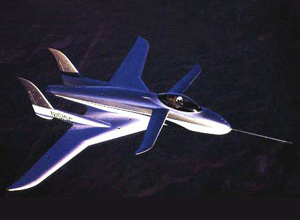 Rutan
151 ARES
Rutan
151 ARES
The 151 ARES (Agile Responsive Effective
Support) was developed by Burt Rutan as a low cost
fighter. The ARES first flew on February 19, 1990.
Since that first flight, the 151 ARES has flown
more than 250 hours. |
|
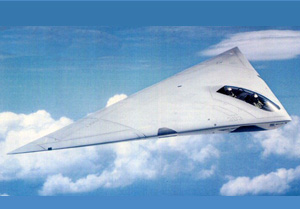 General
Dynamics A12 Avenger II
General
Dynamics A12 Avenger II
The McDonnell Douglas/General Dynamics A-12 Avenger
II was designed to be an all-weather, stealth attack
replacement for the A-6 Intruder used by the United
States Navy and Marines. It suffered several problems
throughout development, especially with the materials
used and the overall price of the aircraft - an
estimated US $165 million per unit. It was canceled
in January of 1991. |
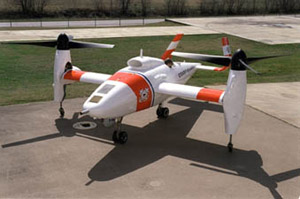 Bell "Eagle Eye" UAV
The Bell Eagle Eye UAV is an unmanned
tilt rotor aircraft which is used for surveillance.
It doesn't require a runway, and it can operate
from land or sea based platform. This picture shows
an Eagle Eye in US Coast guard livery.
|
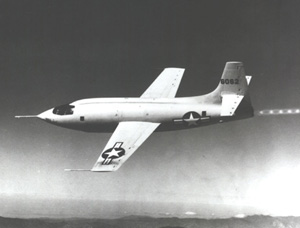 Bell X-1
The Bell X-1 rocket powered aircraft of the US Airforce,
piloted by Chuck Yeager broke the sound barrier
On October 14, 1947. Amazingly Yeager had broken
two ribs in a horse riding accident the weekend
prior to the flight. He kept the injury hidden from
his superiors in order to fly the mission. Because
of his injury, to close the entry hatch Yeager had
to use a sawn off broom handle with his left arm! |
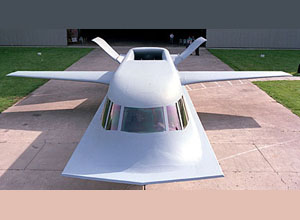 Northrop
Tacit Blue
Northrop
Tacit Blue
The Tacit Blue was created to test
stealth technology. The USAF, DARPA, and Northrop
worked together from 1978 to 1985 to prove that
curved surfaces on an aircraft result in a low radar
return signal from ground based radar. Tacit Blue
made its debut flight in February 1982, and it flew
134 more times before 1985 when the project ended. |
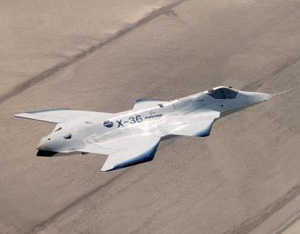 NASA
Boeing X-36
NASA
Boeing X-36
NASA and McDonnell-Douglas Phantom
Works developed the technology essential for a tailless
aircraft beginning in 1989. To prove the technology
worked Phantom Works built two unmanned X-36 aircraft.
The first flight of the X-36 took place in May 1997.
One of the two X-36 aircraft completed 31 successful
research flights the last in Dec 1997. In 1998,
the X-36 made two more flights to prove that software
could make the necessary adjustments to fly a damaged
tailless aircraft. |
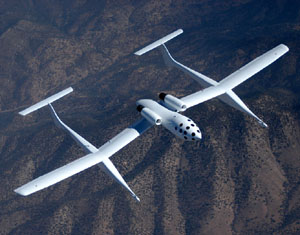 Scaled
Composites White Knight
Scaled
Composites White Knight
White Knight was developed as the
mothership to SpaceShipOne, the first private spaceship
which won the ANSARI X-Prize. |
|
|
Related Sections:
Aircraft
Strange
Aircraft
|
