|
Introduced
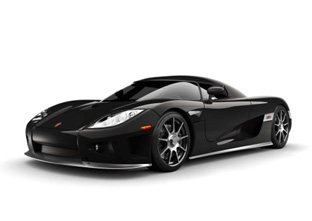
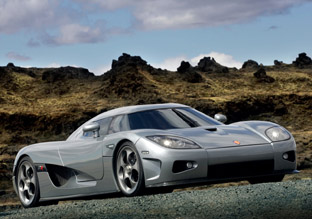
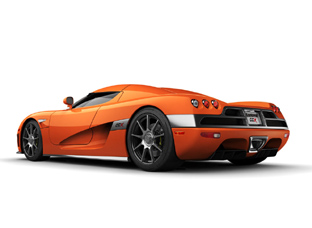
at the 2006 Geneva Motor Show, the Koenigsegg CCX holds the
prestigious honor of being the second fastest production supercar,
behind the Bugatti Veyron.
The Koenigsegg CCX is an impressive piece of engineering,
like the Koenigsegg CCR and CC8S models also offered by the Swedish maker.
Developing 806 bhp from the supercharged V8 engine, and weighing
just 1180 kgs (2601 lbs), the Koenigsegg CCX sprints to 60
mph in just 3.1 seconds, going onto a top speed of around
245 mph (395 km/).
Koenigsegg CCX press release:
The Koenigsegg CCX is the latest iteration of the Koenigsegg
CC family. The CCX is in many ways a new car since it has
been re-engineered to comply with the US regulation and market
demands. Still, it has been a key issue for the Koenigsegg
Team to keep the distinctive and record braking CC shape.
Koenigsegg believes it is important to avoid trends and instead
hone the aerodynamic shape of the CC range for the future,
only enhancing its unique look and appearance with tighter
lines and a more aggressive stance. Koenigsegg also believes
in continuity. A new Koenigsegg shall show a clear lineage
from its predecessor and shall not follow any other design
trends, but enhance its already proven concept and shape to
perfection.
CCX stands for Competition Coupe X. The CCX marks the 10th
anniversary of the completion and test drive of the first
CC maiden prototype, which rolled out from the R&D department
in 1996.
Body and Interior
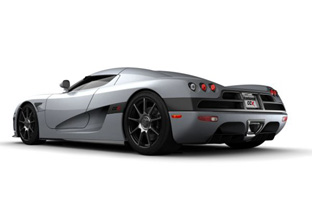
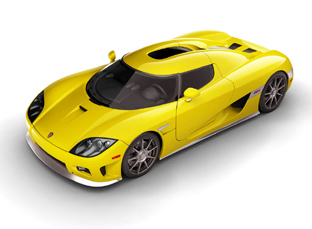
The Koenigsegg CCX features a completely new set of body and
interior parts. The body incorporates a new front bumper design,
engineered to function well in the stringent 2.5 mph bumper
test, including enhanced brake cooling, fog lamps and US side
position lights. The front lamps have been slightly redesigned
to suit the new bumper line.
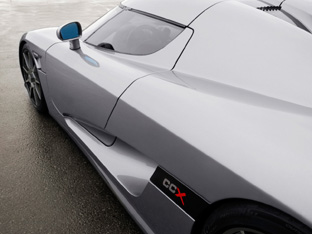
There is a new scoop on the front bonnet as a larger fresh
air-intake for the occupants and new air vents have been added
behind the front wheels in order to further evacuate air from
the cockpit. The frontal shape revisions now allow for effective
track use options to be added.
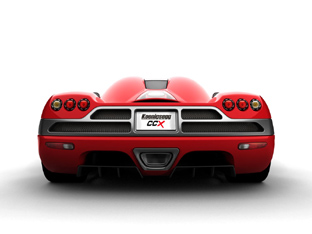
The car is 34.3 inches longer in order to comply with the
US rear impact regulations, and in order to free up space
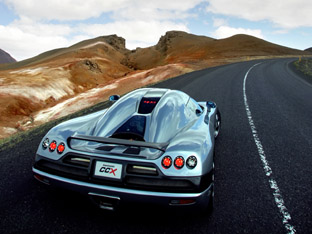
around the rear muffler. The rear clamshell now features a
glass window over the new CCX engine, clearly showing off
the custom made and unique Koenigsegg Block casting.
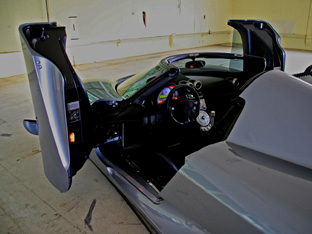
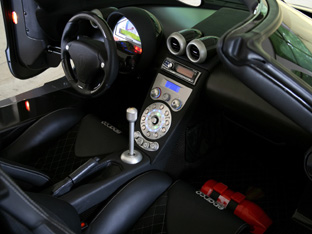
The Interior
There are further 2 inches of space in headroom, making the
CCX the most spacious super car on the market.
In corporation with Sparco, and Koenigsegg test driver Loric
Bicocchi, Koenigsegg has developed a new seat design for the
CCX. The structures of the seats are still carbon fiber, but
now fully padded front surface and a tilting backrest.
Wheels and Brakes
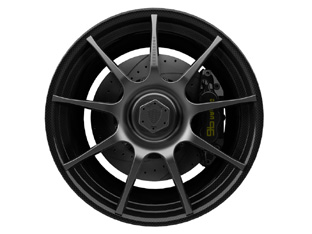
The optional 382 mm front discs are coupled to 8-piston calipers
and in the rear the 362 mm size is retained with 6-piston
calipers. The optional industry-first carbon fiber wheels
save another 6.6 lbs per wheel compared to the already lightweight
magnesium wheels that come as standard.
Ram Air Engine Booster
Between the raised speedster bumps there is a new type of
vortex generator implemented as a Ram Air engine booster by
Christian Koenigsegg on the CCX. Due to the fact that there
is a fresh air intake right below the rear window, the vortex
generator redirects the air directly into the air intake and
thereby creating a positive pressure in the air box.
Unique Koenigsegg Engine
The engine in the Koenigsegg CCX retains the incredible performance
and power of the CCR engine, while running on US 91 octane
fuel and complying with California emission regulations. In
order to reach this challenging goal, extensive rework had
to be done to emission related items, such as new cylinder
heads with larger valve area and more optimally flowing cylinder
head ports. Dual smaller injections per cylinder were integrated,
as well as new camshafts, a new carbon fiber individual runner
intake plenum, a new engine management system, updated fuel
and EVAP system.
Koenigsegg stands out among low volume super car manufacturers,
because they engineer the engine completely in-house in combination
with the fact that it is also built, assembled, and dyno tested
in the Koenigsegg production plant. The Koenigsegg engineers
also incorporated the most powerful internal piston coolers
in the industry - bringing down the piston temperature by
as much as 80% more than competing systems, which was a must
in order to run high cylinder pressure with 91 octane fuel.
Made for a Select Elite of Enthusiasts
Koenigsegg manufactures exclusive sports cars for a select
elite of enthusiasts. Spaceage materials and uncompromising
quality both in finish and function make these cars among
the very best in the automotive history.
|