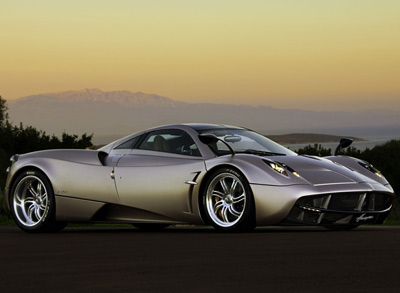
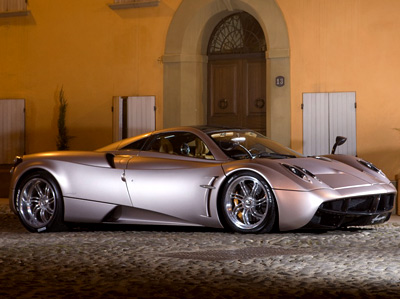
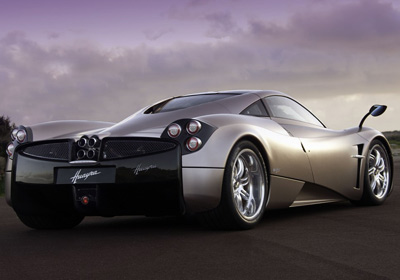
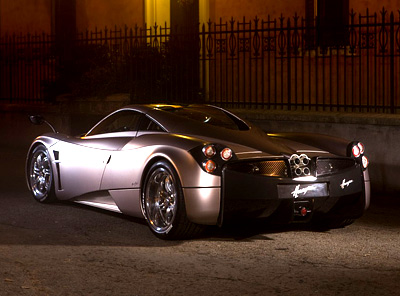
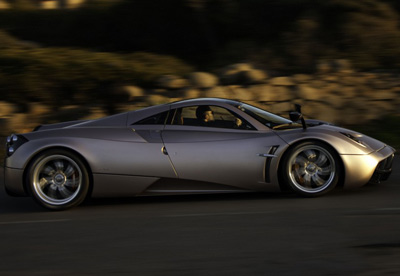
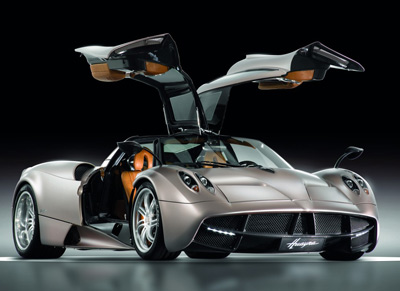
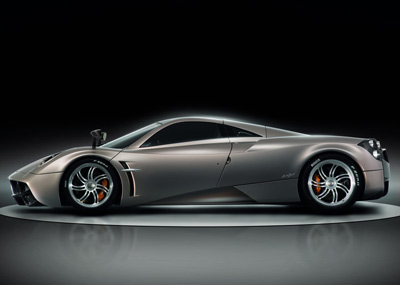
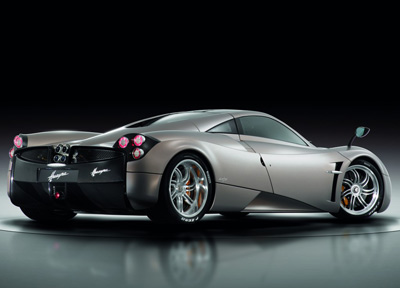
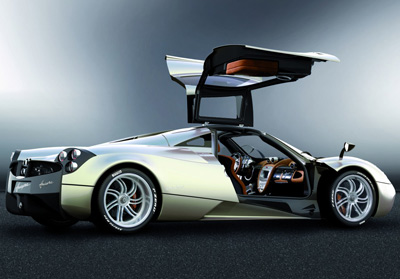
The Pagani Huayra is the latest supercar from Pagani Automobili.
The styling of the Huayra is more of an evolution of the Zonda's
than a complete revolution.
The Huayra has come in for some considerable criticism in the
looks department, mainly from people who don't like the gaping
front grille - and it's also been compared rather unfavorably
with a catfish. Of course there are others who think the Huayra
is a dramatic design which also manages to avoid looking like
yet another generic supercar.
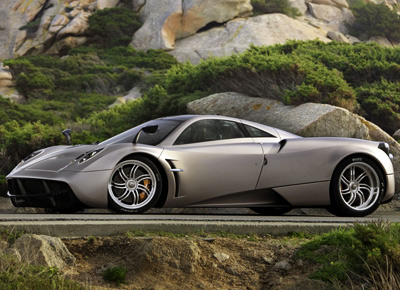
Personally I think the Huayra is a quality design which will
stand the test of time. It's instantly recognizable as a Pagani
model - even without the badges - so it nicely complements the
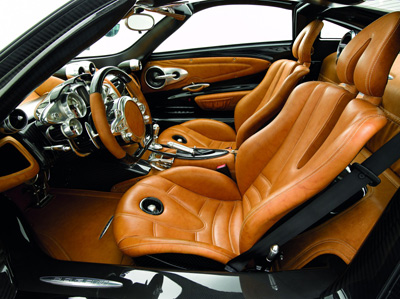
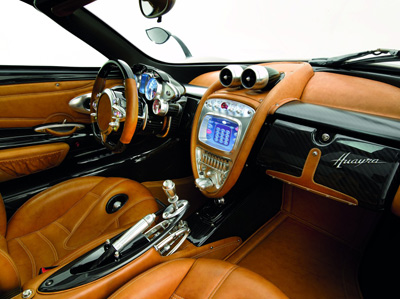
outgoing Zonda. And the interior styling is out of this world!
An area in which everyone will agree the Pagani Huayra is a
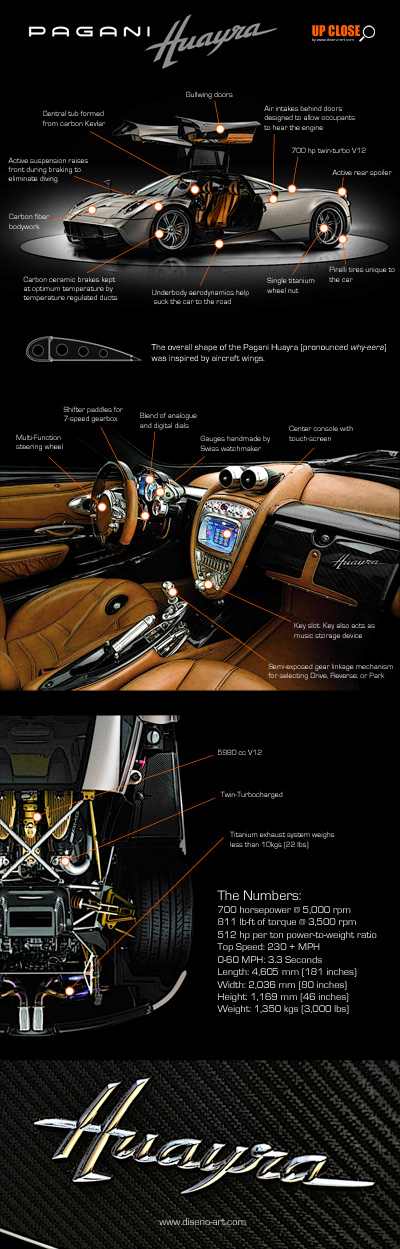
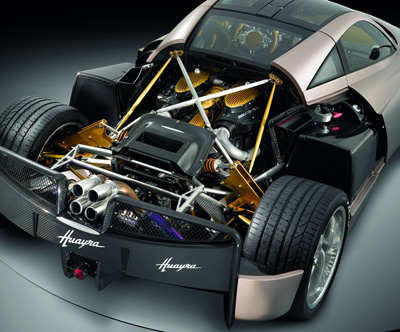
success is the engineering and drivetrain. Mounted behind the
cockpit, within the carbon-titanium monocoque chassis, is a
6.0 litre V12 twin-turbo engine which produces 700 horsepower
and 1000 Nm of torque. The turbos have been engineered to offer
an instantaneous power boost, negating the effect of turbo-lag.
The Huayra's transmission is handled by a 7-speed sequential
gearbox and dual-disc clutch. All 700 horsepower is channeled
to the rear wheels.
Similar and related vehicles:
Pagani Zonda F
Pagani Zonda F Roadster
Pagani Zonda C12S
Pagani Zonda Roadster
Pagani Zonda R
Pagani Zonda Cinque
Pagani Zonda Cinque Roadster
History and official information of the Huayra from Horacio
Pagani:
After seven years of hard work I am now able to tell you a little
brief history and the path that led to the birth of the Huayra,
project name C9.
The concept was born in 2003, the year of the introduction of
the Zonda S Roadster. As you may recall the early 2000s were
prosperous for the world of supercars. The commitment of big
car manufacturers have contributed to the rise of extraordinary
cars like the Bugatti Veyron,
Porsche Carrera GT, Ferrari
Enzo, Mercedes McLaren
SLR. This context led us to make several observations concerning
the future of the Zonda and what could be a new Pagani. Since
the original design of the Zonda was done in the early 90s the
first thought was that it was now an obsolete project and we
decided to imagine the car totally different in form, dimension,
dynamics and technology, all this without losing the essence
of our approach, to follow a concept born in the Renaissance
where Leonardo da Vinci told us that art and science are disciplines
that need to walk alongside. The eternal element air in all
its forms, especially wind, became determining in defining the
concept and it was a great inspiration, a sit is ever present
in our lives: a jet turbine, the silence of a glider... the
elegance of the movements the wind creates and helps but also
the violence and force that it can unleash.
The Huayra is made of more than 4000 components (engine and
gearbox not included). To create them and put them together
requires creativity, patience and passion that I shared with
a fantastic young team and with the most competent partner in
all sectors. In defining the size, I immediately thought of
a car that would be longer than the Zonda, a track increased
by 70 mm, a cabin position shifted 40 mm to the back and even
more spacious. The silhouette should be soft, easy to read and
form itself from lean and sleek lines that have a clear beginning
and an end.
As the style is concerned during these five years we have tried
to find the best compromise working on 8 scale models and 2
full scale models, as well as hundreds of drawings without never
leaving the original idea and taking meticulous care of the
details. The ideas were of including elliptical shapes reminding
of our brand in the front and at the back, keeping the central
exhaust as the completion of the line of the canopy, the line
starting at the headlight area that continues and ends into
the air intake. We also thought from the beginning of active
aerodynamics. Flaps that are activated according to the study
of results gathered through calculations and aerodynamic testing.
The whole car is shaped as a wing so it was necessary to create
a high front to reduce the length of the upper part of this
wing to counteract lift. The active suspension in the front
and the 4 flaps allow to optimally balance the drag coefficient
and downforce.
Mercedes-AMG has created a truly unique and lightweight engine,
a twin turbo with over 700 HP and 1100 Nm of torque that perfectly
complements the car giving a feeling that has motivated our
research: that of the brute force of an airplane taking off.
The main focus was in a power delivery that was linear and not
with lag, because that could potentially create safety problems
or a continuous operation of electronic driving aids. Mercedes-AMG
already 5 years ago thought about the coming environmental restrictions
by creating a 12-cylinder engine that is at the peak of efficiency
in terms of CO2 and consumption.
Pirelli has created a very progressive tyre with a exceptional
grip in all situations and with low rolling friction. Every
aspect of safety was treated not only to comply with the highest
standards of the United States but also taking into account
the dynamic by which most accidents with high performance rear
engined cars occur.
While developing the C9 we witnessed the evolution of the different
models of the Zonda and it showed us that the Zonda wasn’t obsolete
as I had originally feared. The Zonda
R has been a key laboratory for the Huayra. The team was
able to work on many projects at the same time driving on different
tracks that occasionally came to meet by sharing engineering
concepts, materials, safety and scientific or design studies.
- Horacio Pagani
Pagani Huayra press release:
DESIGN
Inspired by eternity and the element air. Delicate and ethereal,
yet capable of eroding the most resistant materials, giving
them the forms that we recognize in nature. Elegant, muscular,
Huayra combines past, present and future in the timeless art
of automotive interpretation. The style of the car has been
perfected over five years to give each line a clear beginning
and an equally clear view.
Through hundreds of drawings, eight scale models and two full-size
models, we have gradually refined the shape and substance. This
was achieved through meticulous attention to detail that has
resulted in a continuous and exhausting search for proportion
and elegance.
The bi-xenon headlights, a prestigious heritage of the Zonda
R and LED daytime running lights are harmoniously integrated
into the elliptical shape of the mouth front. The integrated
rear bumper diffuser is dominated by an elliptical frame that
surrounds and enhances the four tailpipes, a symbol of continuity
and a characteristic feature of the Pagani brand.
SPINE
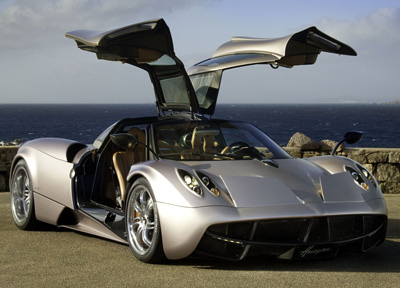
The all-new monocoque central to the Huayra is built in carbon-titanium,
it features gull-wing doors that include a good portion of the
roof. The design focused on the application of advanced composite
materials and technologies first tested on the Zonda R, to achieve
the highest levels of rigidity combined with minimum weight.
The fuel tank is positioned in the most protected are behind
the driver, reinforced by a safety cell made of different composite
materials and ballistics. The semi-chrome-moly frames provide
a stiffness to weight ratio allowing the suspension to work
exceptionally well and to incorporate an advanced absorption
of energy, ready to protect occupants in case of an impact.
The constant quest for weight reduction has led to an ingenious
combination of aesthetic and structural harmony. One example
comes from the pipes of the cooling and air conditioning: the
ambitious choice of integrating them into the monocoque structure
has rendered superfluous the inclusion of additional components.
The result of the reduction program is summed up in a vehicle
weight of 1350 kg.
HEART
Mercedes-AMG provides the heart of Huayra. The 6.0 litre, 12-cylinder,
biturbo engine with 60 degree V has been developed to meet not
only the technical application and the strictest quality aspects,
but also to give the car its dual character. The calm and harmony
that is perceived to drive one of today's finest GT's is interrupted
when the pilot calls on the Huayra to unleash its power of over
700 hp and over 1000 Nm of torque.
The turbines are designed to offer an immediate response to
the minimum stress of the butterfly, giving the driver complete
control over the power at any speed and preventing unwanted
delays in disbursement. The two radiators on the sides of the
front grille ensure the best cooling efficiency of the intercooler
located above the cylinder head. This cooling system at low
temperature is designed to operate in adverse conditions of
Death Valley with temperatures above 50 degrees Celsius.
The dry sump lubrication also feeds the engine when the car
is subject to extreme lateral acceleration. It also regulates
the oil flow so that only the required quantity of lubricant
is pumped into the engine from the external tank, reducing the
friction caused by an excessive volume of fluid inside the base.
The dry-sump oil pan makes obsolete the conventional one, allowing
you to mount the engine lower and in turn have a lower center
of gravity.
A heat exchanger oil / water reduces engine heat loss during
cold starts and keeps the refrigerant and lubricant temperatures
stable. Extensive weight reduction programs have resulted in
simple yet ingenious solutions. In order to limit as much as
possible pipe connections, the expansion tank is mounted directly
on the engine.
Bulkheads intercooler act as reservoirs of the expansion of
low-temperature circuit and the engine coolant circuit. The
M158 engine is certified to the strictest environmental regulations
and EU5 LEV2 and, despite a significant increase in power compared
to engine developed by Mercedes-AMG in the past for Pagani,
fuel consumption and thus CO2 emissions have been killed so
that Huayra holds the record among female athletes to 12 cylinders,
with values close to cars on the market of displacements and
lower powers.
The large 85-liter tank ensures a longer range travel. The power
system in two stages with no return has two power pumps that
send fuel to the engine by activating the second pump when needed.
To further increase the demand for fuel efficiency is controlled
by a microprocessor on each pump, releasing the required amount
from the engine control at any particular time.
This reduces the energy needed to operate the fuel pump and
eliminates the waste of excessive fuel transport and heating
ducts of gasoline. As a tribute to the decade-old tradition
of Mercedes-AMG to build engines in the world for sports cars,
the M158 boasts the historic AMG emblem on the intake manifold,
along with the name of the technician who hand-assembled the
unit at the Mercedes-AMG headquarters in Affalterbach Germany.
The titanium exhaust system has been engineered by MHG-Fahrzeugtechnik
and is a direct application of technologies racing on a high-performance
road car. The hydroformed junctions have been developed to reduce
the pressure and ensure a free flow of exhaust gases. Titanium
offers a limited role in the silencer while offering reliability
Iconel exhaust parts most exposed to high temperatures.
The full exhaust system weighs less than 10 kg and research
undertaken to ensure maximum pleasure sound translates into
a harmonious and deep roar that portends a wave of power ready
to erupt with a roar, accompanied by the hiss generated by aircraft
intakes' air.
FEET
The power and enormous torque is transferred to the wheels via
a seven-speed sequential gearbox cross and a dual-disc clutch.
The adoption of a dual-clutch in oil bath was discarded because
it would lead to an increase in weight over 70 kg, negating
the advantage of a changed little faster. The entire transmission
weighs 96 kg.
Its small size made it possible to reduce the rear overhang,
providing a more neutral behavior in extreme conditions and
improving safety in the event of a rear crash. Xtrac, already
supplies the changing of the Zonda R, was therefore the natural
choice for the development of a road exchange high performance.
For Huayra was made a change that provides a level of comfort
combined with a high rate of change comparable to that of a
car on the track.
The suspension geometry was designed to further enhance the
behavior accurately and without hesitation he made famous the
Zonda, the entire Huayra longer. The independent suspension
with double arm, forged Avional were tested at length on the
Zonda R. Their league, which offers a weight reduction of 30%
compared to the common aluminum, has led to some of the lightest
uprights.
These were connected to the cooling ducts, which prevent overheating
of the bearings connected to the hubs, thus prolonging life.
Öhlins adjustable shock absorbers have been linked to groups
with special wheel pivot, arranged in the corners that have
optimized the dynamic characteristics of the car.
"Power is nothing without control" following this famous slogan,
Pirelli engineers have been faced with the demanding task of
combining a perfect grip, and an exciting driving experience
less rolling resistance to reduce CO2 emissions . It is in Pirelli
P Zero tires, developed, built inside "MIRS" Modular Integrated
Robotized System, the department dedicated to producing high-performance
tires and designed to ensure complete control of the pilot.
Designed to fit Huayra, transcend the state of the art, suitable
as never before at speeds above 370 km / h with lateral forces
than 1.5 G.
SKIN
Think Huayra as a wing, able to actively change its angle of
attack by changing the height of the front from the ground and
operating independently of the four flaps placed at its ends.
The result is that the machine constantly change its shape,
from time to time to ensure the minimum friction coefficient
and the maximum downforce.
A commanding this unit is a dramatic metamorphosis, which receives
and processes information about speed, yaw rate, lateral acceleration,
steering angle and throttle position, and act so as to obtain
a car from neutral behavior in all conditions, the correct aerodynamic
roll and braking.
Thanks to a thorough search it was possible to exploit the fluid
pressure gradients to generate spontaneous flow of extraction
from the radiators. In particular, the central air is extracted
from the radiator is on the bonnet and through the arch, an
angle that does not contaminate the stream that flows around
the body, while the air from the radiator side is channeled
in the cooling ducts of brake discs and hubs, and breathe on
the brakes at a temperature of about 50? ° C heat and thus raise
the initial speed of the system during braking.
The side air intakes behind the front wheels generate a negative
pressure inside the wheel, causing a draw that effectively lowers
the coefficient of aerodynamic drag and downforce generating
front. The shape of the two air intakes engine, behind the backs
of the occupants, is a tribute to the most advanced supersonic
aircraft of the '50s and '60s.
The connection for the exchange of the radiator is positioned
behind the glass window above the engine, where a conveyor feeds
the appropriate carbon heat exchanger without having a substantial
impact on friction aerodynamics. To meet the design specifications
on downforce has recreated a low turbulence flow at the top
of the car to work the best two back flap, perfectly integrated
into the body, thus generating a negative lift further amplified
by two areas of strong negative pressure created from the bottom
and rear diffuser.
MAN-MACHINE
As soon as the doors close Huayra transports its occupants to
a new dimension, a world of meaning, to satisfy and surprise
the sight, smell, touch and emotion. The driver will find all
the primary functions on the steering wheel. The paddles are
mounted directly on the steering gear so you can change without
taking your hands off the steering wheel.
The seats provide comfort for long journeys but also the lateral
support given the enormous lateral forces that the car is able
to develop. Driving means driving a Pagani state of the art
without forgetting the roots and history. The eye can not dwell
on the leather laces and a spinner on the switches, then lost
the manual transmission, shiny sculpture that embodies progress
and tradition.
The aluminum panel was inspired by the most sophisticated Swiss
watches and includes a central multifunction display that shows
information relevant driving in sport mode and a trip computer
when you select the Comfort mode. The center console aluminum
is machined from a single block of anticorodal and inspired
by the keys of a clarinet, with push buttons for controlling
the heating and air conditioning.
The central touch screen high-definition multimedia system is
the heart of the vehicle for the control of audio functions,
satellite navigation, Bluetooth phone and secondary functions.
ON THE ROAD
Over the past four years we have conducted our tests with prototypes
for over five hundred thousand kilometers. Before entering the
U.S. market we will have one million tracks. Each prototype
was assigned to a specific development: Mercedes-AMG uses one
for the study of driving and one for the reduction of emissions
of the engines, and a third car is constantly at Bosch Engineering
to implement ABS, stability advanced and systems performance
improvement, while another vehicle is dedicated to the development
of exchange and the dynamic behavior.
SAFETY
The car fully respects the most exacting standards of Europe
and the United States in terms of safety and environment. In
addition, specific research has been conducted to study the
dynamics most often involving this type of car accident. Several
cars were used to validate these tests. The survey showed that
the evaluations have led us to apply concepts of construction
not specifically required by law but how to improve occupant
protection.
|