|
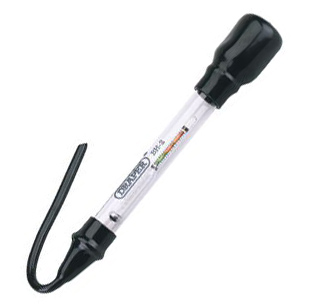
A
battery hydrometer is an instrument that checks the charge of a
battery by measuring the density of the electrolyte in the cells.
Although not a substitute for a battery performance, a hydrometer
reading gives a valuable first indication that there may be a charging-system
failure.
A battery hydrometer consists of a rubber squeeze bulb, a floar
chamber, and an accurately weighted float. The amount of sulfuric
acid in a lead-acid battery indicates the state of charge. The greater
the concentration of acid in the electrolyte, the denser the electrolyte
and the greater the level of charge. Water has a specific gravity
of 1.000; sulfuric acid has an s.g. of 1.830. Each cell in a fully-charged
battery has an s.g. in the range 1.240 to 1.280. The electrolyte
in a totally discharged battery has an specific gravity of about
1.100. Remember that specific gravity falls with increasing temperature.
To use a battery hydrometer draw enough electrolyte into the device
to set the float adrift, without it touching the sides. Sight across
the main level and ignore the meniscus that rises up the sides of
the instrument.
|