| Make
|
Mazda |
| Model |
Kazamai |
| Concept
year |
2008 |
| Production
year |
- |
| Engine |
2.0
litre petrol |
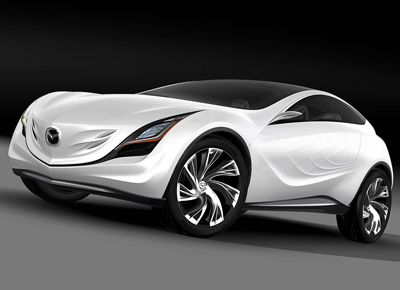
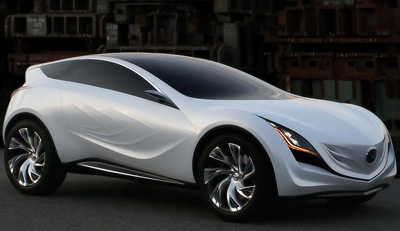
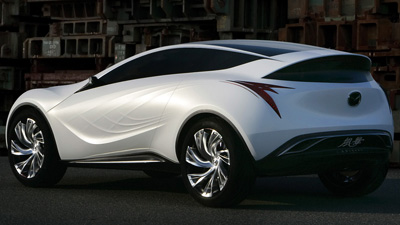
The Mazda Kazamai which was unveiled at the 2008 Moscow
motor show is an SUV concept designed using the same "nature
inspired" styling cues as other recent Mazda concepts.
Following in the footsteps of the Nagare,
Ryuga,
Hazake,
Taiki and
Furai the
Mazda Kazami is styled using naturally occurring phenomenon
as a source of inspiration.
In Japanese the word 'Kazami' means "swirling crosswinds".
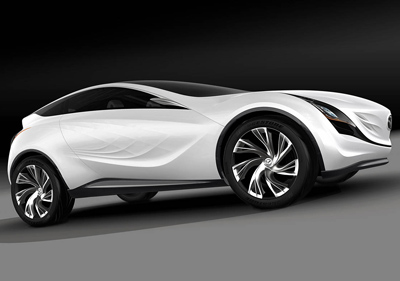
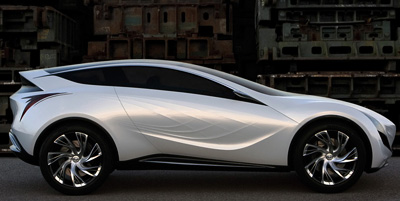
In design language this translates into the subtle lines
on the door panels emulating lines in the sand created
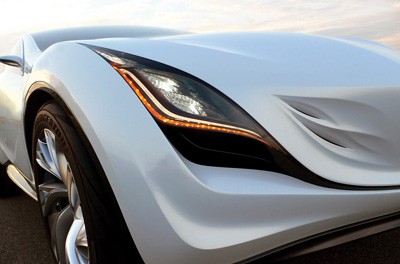
by wind. The air intakes and headlights of the Kazamai
concept also feature lines reminiscent of windswept landscapes.
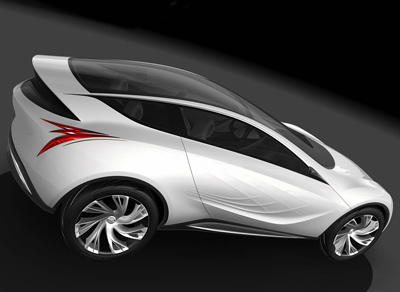
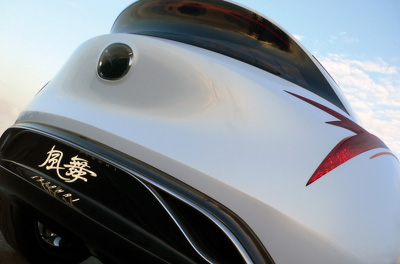
At the rear of the Mazda Kazamai the taillights and sweeping
a-pillar end in highly defined points. This has the effect
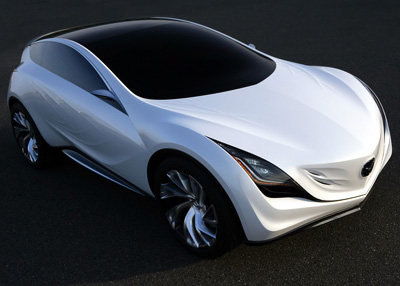
of adding a sense of forward movement. A panoramic glass
roof/windscreen looks good, and at the same time allows
the maximum amount of light into the passenger compartment.
The Mazda Kazamai concept rides on 22" turbine style
wheels. And features an all-wheel-drive powertrain and
direct injection engine.
Similar and related vehicles:
Mazda Furai
Mazda Kabura 
Mazda Ibuki
Mazda Kusabi
Mazda Sassou 
Mazda Nagare 
Mazda Ryuga 
Mazda Hakaze 
Mazda Taiki
Mazda Kiyora
Mazda Kazami press release:
Mazda Kazamai means swirling crosswinds in
Japanese, and was chosen to express the powerful yet nimble
character of this stylish and compact crossover. Kazamai
is dynamic and athletic looking on the outside and displays
an evolved Nagare flow design. Unlike previous
concept cars, Mazda Kazamais styling represents
powerful natural movements that are emotionally expressed
through three-dimensional motifs stretching over the whole
body, representing a fusion of design and functionality.
Mazda Kazamai is an impressive combination of packaging
requirements and design aesthetics. With a width of 1,930
mm and a length of 4,520 mm, it is slightly larger than
the current Mazda3, with room for SUV comfort and functionality
on the inside. Yet, because it is only 1,500 mm high,
has a flat roofline and very short rear overhangs, it
also has a sporty coupe look with the promise of driving
fun. The innovative body design features flared fenders
that emphasize SUV-like strength and a cabin befitting
a sports car. The wedge-shaped profile was designed to
evoke the image of a sleek arrow cutting through a mighty
wind. In particular, the body design between the front
wheel arches and the roof pillars is intended to express
the agility and dynamism of wind gusting along the side
of the vehicle. The panel lines on the sides represent
swift and elegant crosswinds, further accentuating the
dynamic and stylish body design. The bonnet itself is
lower in the centre than on the sides, which emphasizes
the cars powerful front fenders that accommodate
large, 22-inch wheels.
The wheel design continues the crosswinds motif with each
spoke carefully twisted and larger outside than in the
centre, providing a strong sense of movement. The five-point
grille is integrated into the body to create a clean and
light image which, together with the flared front lower
sides contributes to excellent aerodynamic characteristics.
The aerodynamics are further improved by making the air
intakes as small as possible. The side sill panels and
rear combination light covers also help to control the
wind flow and reduce drag even further.
Mazda Kazamai is not only a pure expression of speed and
power, it also accommodates up to four passengers with
compact SUV comfort and functionality. It was designed
to fulfil various driver and vehicle interfaces so as
to support the driver in enjoying safe and stress-free
driving, with well considered human machine interface
visibility and operation cockpit. This is one of Mazdas
important areas of the Sustainable Zoom-Zoom plan.
Weight reduction and superior aerodynamic performance
are core technologies to improve both driving pleasure
and environment performance, especially fuel economy.
Mazda will further focus on these crucial factors in order
to achieve the goals of the Sustainable Zoom-Zoom plan.
Despite its powerful exterior look, the Mazda Kazamai
concepts aerodynamic performance is achieved through
a flat floor panel, a rear diffuser, and a low roof line.
The aim was to make the Kazamais aerodynamics more
than 10% better than other vehicles in its class.
When Mazda set about reducing the bodyweight, they leveraged
CAE applications and focused on four major areas: collision
safety, handling, NVH, and strength. At the same time,
lightweight materials and new processing/joining technologies
were put to effective use. Aluminium or aluminium-alloy
is used for the bonnet, chassis and engine block. The
designers aimed to make it 100 kilograms lighter than
similar models by employing plastics for the panels, fenders
and the engine cover. These features also contribute to
advanced handling and improved fuel economy and CO2 emissions.
The ideal match for the Mazda Kazamai concept would be
a next-generation 2.0-litre direct-injection petrol engine,
which Mazda engineers are currently developing. This engine
delivers a balance of sporty driving especially
in a compact car like the Mazda Kazamai with good
environmental performance. Mazda Kazamai will feature
a DISI* engine based on the current Mazda CX-7, with advanced
technologies to minimize energy loss and vastly improved
thermal efficiency. Mazdas next generation 2.0-litre
DISI petrol engine also has combustion control technology
and variable valve control that deliver strong torque
throughout the rev-range for excellent engine response
as well as superior fuel economy. A next-generation catalyst
also ensures superior emissions performance.
*DISI: Direct Injection Spark Ignition
This is coupled to a lightweight and next-generation compact
six-speed automatic transmission that is highly responsive
and delivers the direct feel of a manual transmission,
and four-wheel drive for superior traction. In combination
with Kazamai’s next-generation aerodynamics and its lightweight
body outlined above, this powertrain would deliver an
estimated 30 percent improvement in fuel consumption and
emissions (versus the current MZR 2.0-litre petrol) –
without compromising driving pleasure.
Mazda Kazamai is not only lightweight, fuel-efficient
and fun to drive, it is also designed with safety as a
key element. Its advanced body shell is a product of a
new body structure programme currently being refined at
Mazda with a lightweight structure that provides high
levels of crash safety. Mazda Kazamai also has a long
list of active safety features including roll stability
control, blind spot monitoring to assist lane change,
a pre-crash safety system and advanced dynamic stability
control (DSC) to support the driver. And to meet future
pedestrian safety requirements, it has soft plastic fenders
and a shock-cone aluminium bonnet that is very efficient
in absorbing impact energy.
Also onboard the Mazda Kazamai is a personal security
system. This advanced system monitors the area around
and inside the car, and has an automatic alert system
which informs the driver in the event of an emergency
to help to protect both the owner and occupants. |
|