Top Ten Supercars that
never made it
For every supercar manufacturer that
became successful, there are a dozen which failed. Gobbling
up the money of investors, and the dreams of their creators
in equal measure.
Often times it wasn't due to a bad product. It was either bad
timing - like the middle of a recession, or bad luck - like
the car you're basing it on is suddenly discontinued.
Sometimes it WAS due to a bad product. When people are paying
extraordinary sums of money for a supercar, "that'll do",
and "close enough", are not words the development
team should be uttering!
To qualify for this list there has to have been no progress
or updates on the company or their products in over a year.
|
|
MB
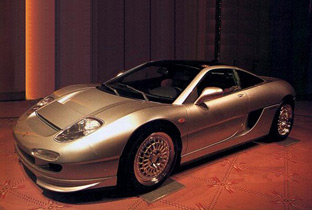
Exigence of Speed
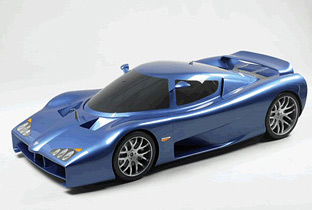
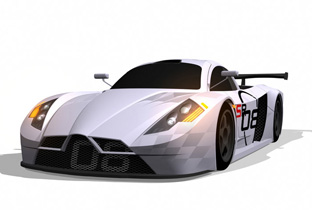
The MB EOS (Exigence of Speed) was never going to win any
beauty contests. But the team behind the car were more concerned
with perfect aerodynamics, than beautiful styling.
Unfortunately, despite it's high tech engineering, and advanced
body design, the MB EOS never made the leap to production.
More
photos and information
|
Bizzarrini
GTS 4.4
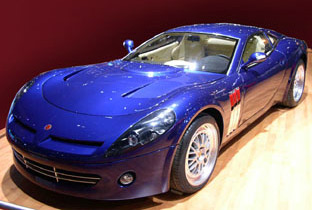
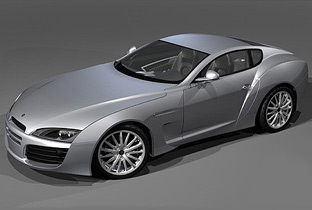
Despite the Italian heritage, 4.4 litre V8 engine, and claimed
224 mph top speed, the Bizzarrini GTS 4.4 faded into dust
after the it's introduction at the 2005 Geneva Motor Show
More
photos and information |
McRae
R4
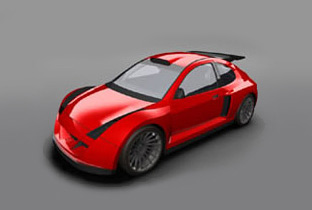
The McRae R4 has a sad story. It was to have been the first
vehicle developed from the ground up with the help and input
of the legendary Scottish racing driver Colin McRae.
Sadly McRae died in a helicopter crash in 2007, and although
it was decided to continue with the project, the project seems
to have ground to halt.
More
photos and information |
Freestream
T1
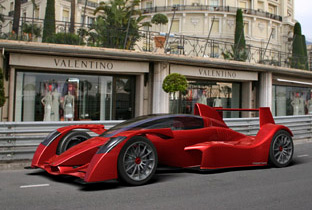
The Freestream T1 isn't really dead, it just changed its name
to the Caparo T1, which is dying - and trying to take as many
auto journalists with it in the process!
More
photos and information |
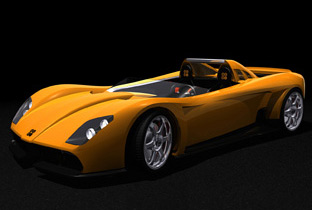
Gigliato
Aerosa
The Aerosa was an ambitious project by Gigliato Design to
bring a Lamborghini engineered, Ford powered, English built
supercar to the streets of Japan...
Oddly it failed to make it to production.
More
photos and information |
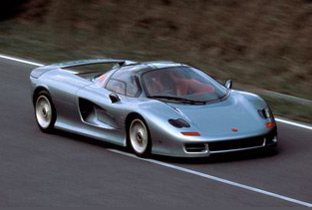
Jiotto
Caspita
The Japanese designed Jiotto Caspita was developed during
the late 1980s and early 90s. The initial prototype was powered
by a detuned Formula One V10 engine.
Despite its astounding performance, the project was canceled
in 1993 because of a global recession.
More
photos and information |
Laboratorio
BEBI Quercianella
The Swedish built Laboratorio BEBI Quercianella was supposed
to offer supercar performance at a reasonable price. But the
projected price of $270,000 (£150,000) was far from reasonable.
Especially for an unknown and untested company offering a
stripped down sports car.
Perhaps it was a combination of price, unpronounceable name,
and unproven engineering which sealed the cars fate. More
photos and information |
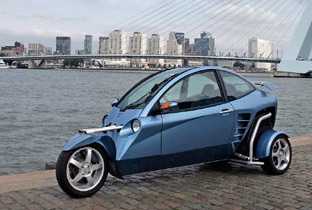
Carver
One
Okay so the Carver One isn't really a supercar, in fact in
most countries it would have qualified as a motorbike had
it made production. But it was super, and some people thought
of it as a car, so that's why it's here.
Unfortunately the Carver One project struggled financially
soon after the first vehicles hit the streets in 2006. By
2009 it was all over.
More
photos and information |
Sunred
SR08
Spain doesn't have a glowing history of producing supercars,
and the Sunred SR08 didn't help change that fact.
The car was designed for use in FIA GT1 racing, and there
were to be 10 roadcars built alongside. Neither made it to
production.
More
photos and information
|
Laraki
Borac
Based in Morocco, Laraki have been trying to get in on the
super car scene for a few years. First they tried it with
the mid-engined Fulgura. Then they changed tack and tried
it with a front engined GT called the Borac. Both of them
have so far failed to garner enough interest to justify a
production run.
More
photos and information |
|
|