Motorcycles > Motorcycle
Frames
Motorcycle frames are usually made from welded aluminium, steel, magnesium
or metal alloy. Carbon-fibre is sometimes used in expensive or custom
frames. The purpose of a motorcycles frame is to act as a base onto
which all the various components can be bolted to. The engine generally
sits inside the frame, the rear swingarm is attached by a pivot bolt
(allowing the suspension to move) and the front forks are attached
to the front of the frame. The frame can also help to protect the
more sensitive parts of a motorcycle in a crash.
Buell, one of the motorcycling world's greatest innovators, uses the
frame as a fuel tank on many of it's models like the XB12S
Lightning.
The various types of frame commonly used include:
Single Cradle Frame
The single cradle is the simplest type of motorcycle frame, and looks
similar to the first ever motorcycle frames. It is made from steel
tubes that surround the engine with a main tube above and other, smaller
diameter tubes beneath. If a single cradle becomes double at the exhaust,
as frequently occurs, it is referred to as a split single cradle frame.
Single cradle frames are usually found in off-road motorcycles.
Double Cradle Frame
Double cradle frames are descended from single cradle frames.
They consist of two cradles that support the engine one either side.
Double cradle frames are commonly used in custom motorcycles and simpler
road bikes. They offer a good compromise between rigidity, strength
and lightness, though they have now been technically surpassed by
perimeter frames.
Backbone Frame
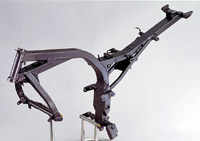 Far
from the most desirable frame around, the backbone frame comprises
a single, wide main beam from which the engine is suspended. The backbone
frame allows for great flexibility in design, since it is concealed
inside the finished motorcycle. The engine just seems to hang in mid
air. It is simple and cheap to make, and is used mainly on naked and
off-road motorcycles. Far
from the most desirable frame around, the backbone frame comprises
a single, wide main beam from which the engine is suspended. The backbone
frame allows for great flexibility in design, since it is concealed
inside the finished motorcycle. The engine just seems to hang in mid
air. It is simple and cheap to make, and is used mainly on naked and
off-road motorcycles.
Perimeter Frame
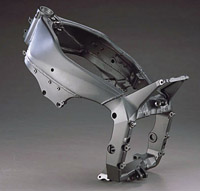 Motorcycle racing research has shown that major advantages are to
be gained in terms of rigidity by joining the steering head to the
swingarm in as short a distance as possible. Flexure and torsion are
dramatically reduced. This is the concept behind the perimeter frame.
Two robust beams descend in the most direct way possible from the
steering head to the swingarm, passing around the engine. The earliest
perimeter frames were made from steel, but the need to improve rigidity
to weight ratios led most manufacturers to adopt aluminium instead.
Aluminium is now by far the most common road bike frame material and
the aluminium perimeter frame is the most popular frame for modern
supersports motorcycles.
Motorcycle racing research has shown that major advantages are to
be gained in terms of rigidity by joining the steering head to the
swingarm in as short a distance as possible. Flexure and torsion are
dramatically reduced. This is the concept behind the perimeter frame.
Two robust beams descend in the most direct way possible from the
steering head to the swingarm, passing around the engine. The earliest
perimeter frames were made from steel, but the need to improve rigidity
to weight ratios led most manufacturers to adopt aluminium instead.
Aluminium is now by far the most common road bike frame material and
the aluminium perimeter frame is the most popular frame for modern
supersports motorcycles.
Monocoque Frame
The monocoque
frame is used nearly exclusively on competition bikes and is very
rarely found on road-going bikes. Monocoque frames act as a single
piece unit that functions as seat mounting, tank and tail section.
Though they offer certain advantages in terms of rigidity, monocoque
frames are heavy and generally not worth the effort.
Trellis Frame
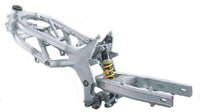 The
trellis frame rivals the aluminium perimeter frame for rigidity and
weight. A favorite of Italian and European manufacturers it has proved
a great success in racing and competition. The Trellis frame uses
the same principles as the perimeter frame, and connects the steering
head and swingarm as directly as possible. The frame is made up of
a large number of short steel (or aluminium) tubes welded together
to form a trellis. The trellis frame is not only easy to manufacture
but extremely strong as well. The frame pictures is from the Suzuki
SV650S. The
trellis frame rivals the aluminium perimeter frame for rigidity and
weight. A favorite of Italian and European manufacturers it has proved
a great success in racing and competition. The Trellis frame uses
the same principles as the perimeter frame, and connects the steering
head and swingarm as directly as possible. The frame is made up of
a large number of short steel (or aluminium) tubes welded together
to form a trellis. The trellis frame is not only easy to manufacture
but extremely strong as well. The frame pictures is from the Suzuki
SV650S.
See Also:
Engines
- Stroke, 2 or 4
- Configuration
Frames
- Introduction
- Types
Suspension and Steering
- Girder front end
- Telescopic forks
- Hub center steering
- Steering dampers
- Rear Shocks
Transmissions
- Manual
- Automatic
- Chain
- Belt
- Shaft
Exhausts
- Position
- Performance
|