Motorcycles > Motorcycle
Transmission Technology
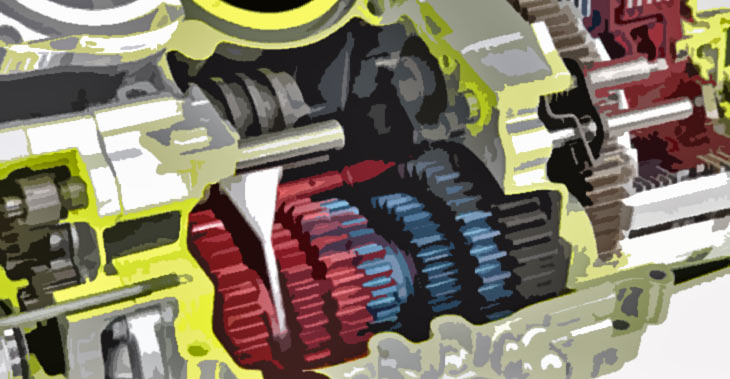
Motorcycle transmissions come in a wide variety of formats. Firstly
there is the transmission itself, manual, automatic or CVT. Then there
is the drive, chain, belt or shaft. Below is a brief explanation of
the most commonly found types of motorcycle transmission systems.
Manual transmissions: Most bike transmissions are manual sequential
gearboxes, with neutral positioned between first and second. After
second gear each gear can only be used in order. Reverse is only fitted
to the largest touring bikes like the Honda GoldWing.
Automatic transmissions can be found in many scooters and some
touring bikes. They have the benefit of providing an easier riding
experience. The drawback is that the rider has less control over the
engine rpm, for example when entering or exiting a corner, or riding
off-road.
Chain drive is the most common form of drive to get power from
the gearbox to the rear wheel. Chains require regular maintenance
and lubrication. They also require periodical adjustment and change
because of the stretching incurred over time.
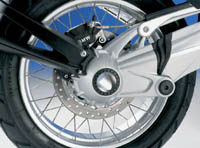
An example of shaft drive
|
Shaft drive is found on many touring bikes and BMW uses them
on many of their models. Shaft drive units are completely enclosed
and almost maintenance free, quiet and clean. Shaft drives drain power
from the engine because of the complicated gearing required, they
are also heavier than chains or belts.
Belt drive is found on many Buell bikes among others. Belts
are quiet, clean and efficient although they do stretch over time
like a chain. Belts are limited in the amount of power they can handle.
See Also:
Engines
- Stroke, 2 or 4
- Configuration
Frames
- Introduction
- Types
Suspension and Steering
- Girder front end
- Telescopic forks
- Hub center steering
- Steering dampers
- Rear Shocks
Transmissions
- Manual
- Automatic
- Chain
- Belt
- Shaft
Exhausts
- Position
- Performance
|