Motorcycles > Motorcycle
Engines
2 or 4 Stroke?
Two-stroke Engines
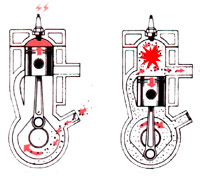
The
two strokes first, intake
and compression, second,
combustion and exhaust. |
The two-stroke engine cycle differs from the more common four-stroke
cycle by having only two strokes (linear movements of the piston),
although the same four operations (intake, compression, power, exhaust)
still occur. Thus, there is a power stroke per piston for every engine
revolution, instead of every second revolution. Two-stroke engines
are light, mechanically simple and produce more power than a similar
size four stroke when running well.
The down sides of a two-stroke are: They are oily and dirty, require
regular maintenance, and power is only available in a narrow rpm band,
often referred to as the power band.
Two stroke sportbikes like the Aprilia
RS250 are well known for their acute handling, lightweight, and
narrow powerband, unfortunately they are no longer produced.
Four-Stroke Engines
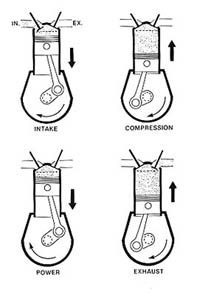
Four-stroke engines are by far the most common type of engines found
in modern motorcycles. The four-stroke engine operates on the exact
same principle as regular car engines except on a smaller scale. Four-strokes
are cleaner, more reliable and power comes across a much wider range
of rpm than two-strokes.
Engine Configuration
Engines come in a variety of cylinder configurations and numbers.
Some general rules which most engines live by are: More cylinders
usually allows for a higher maximum rpm. Less cylinders provide more
torque
at low rpm. And vibrations tend to decrease with more cylinders.
One cylinder, or single cylinder engines as they are commonly
known, are just that. One cylinder, usually positioned vertically
with a single spark plug attached to the top.
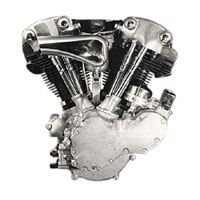 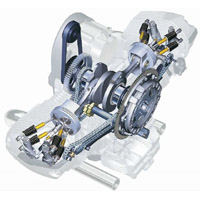
V-twin engine BMW
Boxer twin
|
Two cylinder engines, or twins, are one of the most popular
types of motorcycle engine. V-twins are the most common 2 cylinder
engines, the cylinders are positioned in a 'V' configuration with
both cylinders pointing upwards, V-twin engines power all Harley-Davidson
bikes and many sportbikes with 'character'.
L-twin engines power some Ducati motorcycles, this is essentially
a V-twin with one cylinder pointing horizontally forward.
Parallel twins exist where the cylinders are positioned parallel
to one another.
BMW, and some other manufacturers, produce boxer twin (otherwise
known as flat twin) engines. In a boxer twin engine the cylinders
are opposed to one another and move outward in a manner similar to
a boxer's fists.
Three cylinder engines, or triples are less common. However,
companys such as Triumph and Benelli have produced several triple
engines. Triumph has cornered the market in triples and their newest
sportsbike the Daytona
675 Triple is one of the most desirable bikes on the market today.
Four cylinder engines are similar to small car engines, the
cylinders are normally positioned in an in-line configuration, where
the cylinders are lined up one after another in a line. V and square
twin designs have also been produced.
A far less conventional motorcycle engine, can be found in the MTT
Y2K Turbine superbike. This bike is fitted with an aircraft grade
jet engine, not a common engine choice for motorcycle manufacturers.
See Also:
Motorcycle Engines
- Stroke, 2 or 4
- Configuration
Motorcycle Frames
- Introduction
- Types
Motorcycle Suspension
and Steering Systems
- Girder front end
- Telescopic forks
- Hub center steering
- Steering dampers
- Rear Shocks
Motorcycle Transmissions
- Manual
- Automatic
- Chain
- Belt
- Shaft
Motorcycle Exhausts
- Position
- Performance
|