What
is Torque?
In physics, torque can be thought of informally as 'rotational force'.
Torque is often listed as part of the basic specifications of an engine.
The power output of an engine is expressed as torque multiplied by
rotational speed.
Internal-combustion engines generally produce useful torque over a
limited range of rotational speeds, usually from around 1,000 - 6,000
rpm for a standard car.
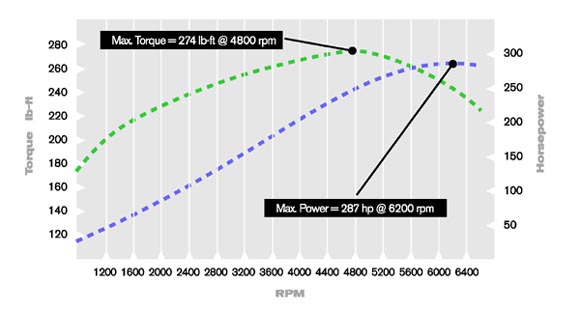
The varying torque output over that range can be measured with a dynamometer,
and shown as a torque curve. The peak of that torque curve usually
occurs somewhat below the overall power (horsepower) peak. The torque
peak cannot, by definition, appear at a higher rpm than the horsepower
peak.
Understanding the relationship between torque, power and engine speed
is vital in automotive engineering, concerned as it is with transmitting
power from the engine through the drive train to the wheels. The gearing
of the drive train (transmission) must be chosen appropriately to
make the most of the motor's torque characteristics.
Below is an example dyno test showing peak torque and horsepower points.
Practical Example of Torque:
You generate a torque any time you apply a force using a wrench. Tightening
a bolt is a good example. When you use a wrench, you apply pressure
to the handle. This force creates a torque on the bolt , this torque
is what causes the nut to turn.
Units of torque are usually measured in pound-feet (lb ft), pound-inches
(lb in) or kilogram meters (Kgm). You will notice that torque measurements
contain a distance and a force. To calculate the torque, multiply
the force applied by the distance from the center.
In the case of the bolt, if the wrench is a foot long, and you put
100 pounds of force on it, you are generating 100 lb ft of torque
on the bolt. If you use a 2-foot wrench, you only need to put 50 pounds
of force on it to generate the same amount torque.
See also:
All Tutorials
How To Check Your Oil
How To Identify Vehicle
Leaks
Basic Tire Maintenance
Take 10 Years Off Your Car's
Appearance
How to Perform a Heel-and-Toe Downshift
Left-Foot Braking
Driving on Snow and Ice
What is Torque?
What is a 'Monocoque'?
What are Superchargers?
|
|
